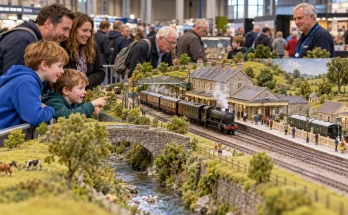
There’s something special about walking into a model railway exhibition and seeing a miniature railway come alive. Steam locomotives glide through countryside stations, freight trains navigate complicated junctions, and tiny buildings create the illusion of an entirely different world.
For visitors, it looks magical.
For the modeller behind the display, however, creating that experience requires serious planning.
Designing exhibition-ready model railway layouts for public displays involves much more than building attractive scenery and laying realistic track.
Unlike permanent home layouts, exhibition railways must survive transportation, repeated assembly, unfamiliar venues, long operating sessions, and hundreds of curious spectators.
And that’s where things get interesting.
A layout that performs beautifully in a home workshop might develop electrical problems, track alignment issues, or awkward operating conditions when moved to an exhibition hall.
Successful exhibition modelling therefore combines creative design with practical engineering, visitor engagement, and operational reliability.
In this guide, we’ll explore how to develop transportable railway layouts that look impressive, operate smoothly, and remain enjoyable for both exhibitors and visitors.
Whether you’re planning your first small exhibition project or developing a larger modular railway, these principles will help you create something worth putting on public display.
1. Establishing a Strong Concept for Your Exhibition Railway
Every memorable model railway exhibition layout begins with a clear concept.
That doesn’t necessarily mean choosing an elaborate historical setting or designing an enormous railway network.
Sometimes, a small countryside station with convincing operations creates a stronger impression than a complicated layout filled with unnecessary tracks.
The secret is understanding what visitors should experience.
Define the Railway’s Story
Before purchasing track components or constructing baseboards, decide what your railway represents.
You might recreate a British Railways branch line during the 1950s, an industrial freight terminal, a modern diesel depot, or a fictional railway inspired by real locations.
Each setting suggests different locomotives, structures, scenery, and operating patterns.
A rural terminus might feature occasional passenger arrivals, locomotive run-round movements, and goods deliveries.
Meanwhile, a mainline junction could focus on continuous train movements and varied rolling stock.
The railway should communicate a consistent identity.
Visitors don’t necessarily need to understand every historical detail, but they should quickly recognise what kind of railway they’re watching.
Consider Your Target Audience
Exhibition visitors have different interests.
Experienced railway enthusiasts may appreciate accurate signalling, realistic train formations, and historically appropriate infrastructure.
Families and younger visitors might be more interested in moving trains, miniature vehicles, illuminated buildings, and small scenic details.
A successful design can appeal to both groups.
For example, a historically accurate goods yard could include a working crane or animated loading scene without sacrificing its realistic appearance.
The National Model Railroad Association’s layout planning guidance emphasises deciding how a railway will be operated before finalising its design.
That advice becomes especially important when the finished project must entertain a public audience.
2. Planning Track Arrangements That Work in Exhibition Spaces
A good exhibition track plan must balance visual interest, reliable running, and practical operation.
It’s tempting to include multiple junctions, platforms, sidings, and complex track formations.
However, every additional turnout introduces another potential maintenance requirement.
For public displays, simplicity often delivers better results.
Choose the Right Layout Configuration
An end-to-end railway can provide realistic station operations, freight movements, and locomotive changes.
This arrangement works particularly well for branch-line termini and industrial railways.
Continuous-loop designs offer a different advantage.
They allow trains to remain in motion, giving casual visitors something interesting to watch even when operators are occupied elsewhere.
A hybrid arrangement can combine continuous running with a small operational branch or goods yard.
Imagine a 3.6-metre-long OO gauge exhibition layout featuring a double-track mainline, a branch junction, and a modest freight siding.
Mainline trains could circulate while a second operator performs occasional shunting movements.
This creates visual variety without requiring an excessively complicated track plan.
The dimensions are illustrative rather than a standard requirement.
Prioritise Reliable Track Geometry
Curves should be as generous as the available space permits.
Long passenger coaches, large locomotives, and certain coupling systems can struggle with tight radii.
PECO’s technical advice recommends selecting track curvature according to scale and rolling stock characteristics.
Avoid unnecessary reverse curves, abrupt gradients, and tightly packed pointwork.
Pay particular attention to hidden track sections.
A derailment inside an inaccessible tunnel can interrupt the entire exhibition.
Create Accessible Hidden Storage
Fiddle yards allow trains to enter and leave the visible scene without requiring a full railway network.
They can contain storage sidings, traversers, or removable train cassettes.
Choose an arrangement that provides enough capacity for your intended operating sequence.
More importantly, leave sufficient space for operators to reach vehicles and correct problems.
A slightly smaller but accessible storage yard is usually more valuable than a larger arrangement hidden beneath complicated scenery.
3. Building Portable Baseboards for Repeated Transportation
One of the biggest differences between exhibition layouts and home layouts is portability.
A permanent railway can remain assembled for years.
An exhibition railway might be dismantled and rebuilt dozens of times.
That means the baseboard structure must withstand regular handling without losing alignment.
Use Modular or Sectional Construction
The NMRA distinguishes between modular layouts and sectional layouts.
Modular layouts use standardised interfaces, allowing compatible units to connect in different combinations.
Sectional layouts contain pieces designed to fit specific positions within a particular railway.
Both approaches can work well for exhibitions.
For instance, a 3.6-metre layout could be divided into three 1.2-metre sections.
Each board would be easier to transport than one continuous structure, although its weight and depth must still be considered.
The ideal dimensions depend on your vehicle, storage arrangements, and the physical ability of the people transporting the railway.
Strengthen Baseboard Connections
Repeated assembly can gradually expose weaknesses in baseboard construction.
Alignment dowels help position adjoining sections accurately, while suitable bolts or clamps hold them securely.
Tracks crossing board joints require particularly careful treatment.
Rail ends should be firmly supported, accurately aligned, and protected during transportation.
Where possible, avoid positioning complex turnouts directly across baseboard joints.
Small changes in alignment can create derailments or electrical interruptions.
Stable construction materials and properly designed frames help reduce twisting and movement.
Plan the Complete Transportation Process
Before building the railway, measure the vehicle that will carry it.
Check door openings, loading height, available cargo space, and whether baseboards can be safely secured.
Remember that the layout isn’t travelling alone.
You’ll also need room for support legs, controllers, lighting equipment, locomotives, rolling stock, and spare components.
Protect fragile structures with removable covers or dedicated transport cases.
Tall chimneys, signals, telegraph poles, and delicate trees are particularly vulnerable.
A practicle transportation system should make packing and unpacking predictable rather than stressful.
4. Designing Reliable Electrical and Control Systems
Electrical reliability is essential for successful exhibition operation.
Visitors may forgive a minor scenic imperfection, but repeated locomotive stalls or malfunctioning points can quickly disrupt the experience.
Fortunately, many electrical problems can be prevented through careful planning.
Install Consistent Track Power Distribution
For larger layouts, a power bus with multiple track feeders can provide more dependable electrical connections than relying entirely on rail joiners.
This approach helps maintain consistent power delivery across different sections.
World of Railways’ article Wiring for Reliability highlights the importance of suitable connectors, correct wire selection, secure connections, and clear identification.
These principles become even more relevant when electrical components are repeatedly disconnected during transport.
Use connectors rated for the expected electrical load.
Include strain relief so cables cannot easily pull away from their terminals.
Label every detachable connection clearly.
A simple wiring diagram can also make fault diagnosis considerably easier.
Select Appropriate Control Systems
Traditional analogue DC control remains suitable for many small exhibition layouts.
It can be straightforward to operate and works well when only one locomotive needs control within a particular electrical section.
Digital Command Control offers greater flexibility for independently operating multiple decoder-equipped locomotives.
However, DCC doesn’t automatically guarantee reliable running.
Dirty track, poor wiring, defective connectors, and incompatible electrical arrangements can still cause problems.
Choose the control system that matches the layout’s actual requirements.
Plan for Electrical Faults
Consider dividing larger layouts into independently protected electrical districts.
With suitable arrangements, a short circuit in one area may be isolated without disabling the entire railway.
Provide convenient access to circuit protection, controllers, and essential electrical equipment.
Use venue-approved power arrangements, keep mains wiring safely enclosed, and follow the organiser’s electrical safety requirements.
Where mains installation or modification is involved, obtain qualified assistance.
A carefully documented electrical system makes exhibition setup faster and unexpected problems easier to adress.
5. Creating Professional Scenery, Lighting, and Visual Presentation
A public exhibition layout isn’t simply a miniature railway.
It’s also a visual presentation.
Visitors experience it from particular viewing positions, often surrounded by other displays, conversations, and exhibition-hall lighting.
That environment should influence the scenery and presentation from the beginning.
Use Scenic Composition to Guide Attention
Think about the layout as a miniature theatre.
The railway is the stage, and the visitors are the audience.
Carendt’s article Theatrical Layout Design explores how framing, sightlines, and controlled viewing angles can strengthen the illusion of realism.
A well-positioned bridge might conceal the entrance to a fiddle yard.
A cutting can make the visible railway feel longer, while buildings near the foreground can create depth.
Avoid placing large structures where they completely obscure the most interesting train movements.
The scenery should support the railway’s story rather than compete with it.
Make Lighting Part of the Design
Exhibition venues rarely provide ideal lighting for miniature landscapes.
Overhead lighting can create shadows, distort colours, or leave important scenic sections looking dull.
An integrated lighting system gives the modeller much greater control.
World of Railways’ guide to layout lighting explains how controlled illumination can improve scenic presentation, particularly at exhibitions.
LED strips or compact LED fixtures can provide consistent lighting while producing relatively little heat.
Use diffusers where necessary to soften harsh shadows.
Consider the colour temperature as well.
A warm rural evening scene requires a different atmosphere from a brightly illuminated modern station.
The lighting should complement the intended time of day and historical setting.
Design Attractive Backscenes and Fascias
Backscenes help separate the miniature railway from the surrounding exhibition hall.
A carefully painted landscape or photographic background can extend the apparent depth of the scene.
Try to match horizon height, perspective, and colours with the foreground scenery.
The fascia should also look neat and professional.
Consistent colours, concealed wiring, and clear layout identification create a stronger first impression.
A small information panel explaining the railway’s location, period, and operating concept can help visitors understand what they’re seeing.
These finishing touches can make even a modest layout feel like a complete exhibition exhibit.
6. Making Model Railway Displays Accessible and Engaging
An exhibition layout should look impressive, but it also needs to be comfortable and safe for visitors.
Public audiences include children, adults, wheelchair users, and people with different viewing needs.
That makes accessibility an important design consideration.
Choose a Suitable Viewing Height
Higher layouts can provide impressive near-eye-level views of locomotives and railway structures.
They may also create problems for shorter visitors.
Lower displays can improve visibility for children, but taller adults may find the viewing angle less immersive.
There isn’t a single ideal height for every exhibition.
Consider the layout scale, expected audience, viewing distance, and venue requirements.
Where suitable, provide alternative viewing positions or approved viewing aids.
Avoid creating obstructions that interfere with wheelchair access or public circulation.
Protect Visitors and Equipment
A delicate railway layout shouldn’t depend on visitors maintaining a perfect distance from it.
Protective barriers, transparent screens, or carefully designed fascia extensions can reduce the risk of accidental contact.
Make sure support legs are stable and that no sharp edges project into public areas.
Cables should be routed securely away from walking areas, with any necessary floor crossings protected according to venue requirements.
Keep emergency exits and accessible routes unobstructed.
The organiser’s safety rules should always take priority over purely aesthetic decisions.
Encourage Visitor Interaction
Public engagement doesn’t require turning the railway into an amusement attraction.
Sometimes, simple explanations make a major difference.
A small sign describing a locomotive’s history or the purpose of a goods yard can encourage visitors to look more closely.
Operators can also explain why trains are performing particular movements.
For example, visitors might enjoy learning why a locomotive must run around its train before departing a branch-line terminus.
Interactive features can be useful when carefully controlled.
A push-button lighting feature or supervised animation may appeal to younger visitors without interfering with normal railway operations.
The aim is to make the display approachable while preserving its character.
7. Developing Smooth and Entertaining Exhibition Operations
Even a beautifully presented railway can disappoint visitors if nothing happens for extended periods.
This doesn’t mean trains should constantly race around the layout.
Instead, the operating schedule should provide believable and regular activity.
Create a Repeatable Operating Programme
Plan an operating sequence that can be repeated throughout the exhibition.
A countryside railway might feature a passenger arrival, locomotive run-round movement, goods train appearance, and local shunting activity.
A busy mainline layout could alternate passenger, freight, and express services.
For example, a fictional 20-minute demonstration cycle might include two passenger movements, one goods arrival, and a short shunting sequence.
This isn’t intended to represent a historical timetable.
It’s simply a manageable exhibition programme that gives visitors opportunities to watch different activities.
The sequence should also allow for occassional delays without disrupting everything that follows.
Organise Operator Responsibilities
Larger layouts often require multiple operators.
Assign responsibilities clearly before the exhibition begins.
One person might control the mainline, another manage the fiddle yard, and a third operate a branch or freight facility.
Avoid creating situations where several people need to use the same controller or reach the same area simultaneously.
A short operating guide can explain train movements, turnout positions, emergency stops, and fault-handling procedures.
This is particularly helpful when club members take turns operating the display.
Balance Realism and Entertainment
A realistic railway doesn’t always have constant activity.
However, visitors arriving midway through a quiet period may assume the layout isn’t operating.
Consider including subtle movement or planned demonstrations that communicate what is happening.
An operator might explain a freight movement while positioning wagons.
Alternatively, a separate continuous circuit can provide occasional background activity without compromising the main operating concept.
The important thing is maintaining an interesting and understandable experience.
8. Testing Exhibition Readiness Before the First Public Display
The final stage is making sure the complete railway performs reliably outside the workshop.
A few successful test runs aren’t enough.
Exhibition conditions involve extended operating hours, frequent handling, and unfamiliar environments.
Perform a Full Assembly Rehearsal
Assemble the entire layout using the same procedures intended for the exhibition.
Connect every baseboard, fit the lighting structure, install the backscene, and test the electrical system.
Record how complicated the process is and identify steps that could be simplified.
Try completing the assembly with the same number of people who will attend the actual event.
This can reveal awkward lifting requirements or connections that are difficult to reach.
It’s also a useful opportunity to confirm that all the necessary tools and components have been packed.
Test Complete Operating Sessions
Run the railway for an extended period rather than testing only individual locomotives.
Use the longest trains, most difficult pointwork, and busiest operating sequences.
Pay particular attention to track joints, coupling performance, and low-speed locomotive running.
World of Railways recommends checking track alignment, wiring, and other mechanical details when improving layout reliability.
Keep a record of recurring failures.
If derailments repeatedly occur at the same turnout, investigate the geometry instead of assuming the rolling stock is responsible.
Fix the cause before the exhibition.
Prepare for Unexpected Problems
Even well-maintained layouts occasionally experience faults.
A spare locomotive, replacement connector, track-cleaning equipment, and basic tools can help resolve common problems.
Keep operating instructions and wiring diagrams accessible.
It’s also sensible to create a reduced operating programme that works if a particular section becomes unavailable.
For example, a mainline layout could continue running a limited service while an isolated goods yard is repaired.
This kind of contingency planning improves overall reliablity without requiring expensive equipment.
Learn From Every Exhibition
Once the display has been exhibited, evaluate how it performed.
Record setup difficulties, visitor feedback, recurring faults, and operating bottlenecks.
Notice which scenic areas attract attention and whether visitors can easily understand the railway’s activities.
You may discover that a small change to lighting or viewing angle makes a significant difference.
Perhaps a particular train movement attracts more interest than expected.
Use that information when refining future operating schedules.
Exhibition layouts often improve through repeated public use, and thoughtful adjustments can be more valuable than major reconstruction.
Designing exhibition-ready model railway layouts for public displays requires a careful balance between creativity, engineering, reliable operation, and visitor experience.
From portable baseboards and dependable wiring to realistic track arrangements, professional lighting, and accessible viewing positions, every detail contributes to the final presentation.
The best exhibition layouts aren’t necessarily the biggest or most technically complicated. They’re the ones that transport easily, assemble consistently, operate smoothly, and give visitors a memorable experience.
Start with a clear railway concept, plan around realistic operating requirements, and build portability into the structure from the beginning.
Most importantly, test the complete system before presenting it publicly.
Ready to bring your miniature railway to an exhibition? Begin with a practical design, refine the details through testing, and create a display that railway enthusiasts and casual visitors can enjoy together.