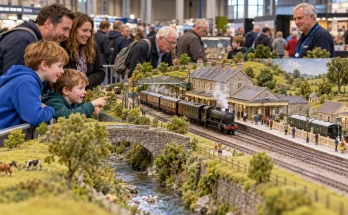
Imagine spending months building an incredible model railway layout. Every locomotive runs smoothly, the scenery looks fantastic, and the miniature station captures the atmosphere of a real British railway.
Then exhibition weekend arrives.
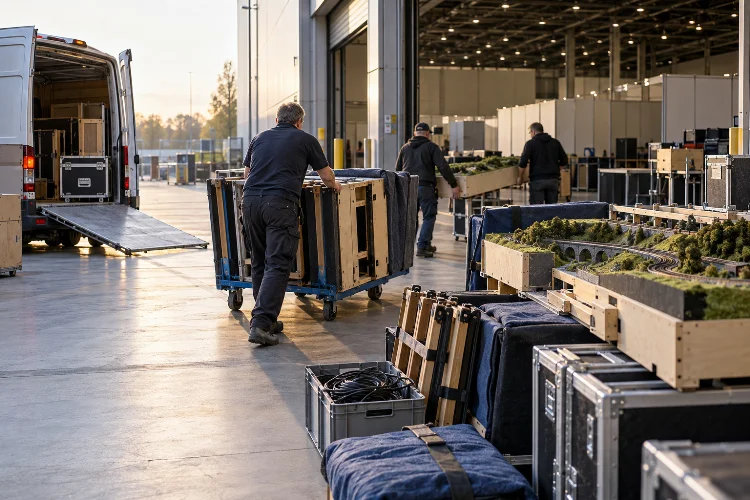
Suddenly, you’re dealing with fragile baseboards, awkward loading arrangements, limited vehicle space, tangled cables, and a venue that seems much smaller than expected.
Sounds stressful, doesn’t it?
Transporting and assembling exhibition layouts can be surprisingly complicated, especially when dealing with large modular displays, delicate scenery, and sophisticated electrical systems.
That’s why optimizing railway exhibition layout transport and setup logistics is essential for anyone participating in model railway shows.
A well-organised transport strategy protects your models, reduces setup time, improves safety, and allows exhibitors to concentrate on what really matters: delivering an enjoyable railway experience.
Whether you’re preparing a compact OO gauge layout for a local Suffolk exhibition or transporting a large O gauge display across Britain, careful logistics can make an enormous difference.
This guide explores practical solutions for packaging, vehicle selection, loading procedures, venue coordination, equipment management, and efficient exhibition setup.
1. Understanding the Challenges of Model Railway Exhibition Logistics
Taking a model railway to an exhibition involves much more than moving a few baseboards from your workshop into a vehicle.
Unlike ordinary furniture, railway layouts contain sensitive components that can be damaged by vibration, pressure, poor handling, or sudden movement.
Track joints, miniature signals, scenic structures, electrical connectors, and point motors all require attention.
Why Exhibition Layouts Need Special Planning
A typical exhibition railway may consist of several baseboards, detachable legs, lighting supports, controllers, cables, and boxes of rolling stock.
Every component must arrive safely and be assembled in the correct order.
One missing connector or damaged track joint can interrupt the entire display.
The difficulty increases when exhibitors travel long distances or rely on hired transport.
A railway club attending an exhibition in East Anglia, for example, might need to coordinate several vehicles, multiple operators, and a limited setup window.
Without planning, unloading can quickly become chaotic.
Creating a Complete Equipment Inventory
Start by documenting everything required for the layout to operate.
Record baseboard dimensions, weights, electrical components, lighting equipment, storage cases, tools, and support structures.
Give every major component a unique identifier.
For example, baseboards might be labelled B01 through B06, while electrical cases use E01 and E02.
This simple system makes packing and unloading considerably easier.
Photographs can also help identify where components belong, particularly when different club members are responsible for transporting seperate sections.
The objective is straightforward: everyone should know what is travelling, where it belongs, and when it will be needed.
2. Designing Modular Railway Layouts for Easier Transportation
Transport efficiency actually begins during the layout’s construction.
A beautifully detailed railway may become difficult to exhibit if its baseboards are too large, too heavy, or impossible to separate safely.
Experienced exhibition modellers often consider transportation requirements before laying the first section of track.
Choosing Practical Baseboard Dimensions
Modular baseboards are easier to handle when their dimensions match the available vehicles, storage areas, and venue access routes.
There’s no universal ideal size.
A compact OO gauge layout might use manageable sections approximately 1.2 metres long, while a larger exhibition railway may require a completely different arrangement.
The Neely exhibition layout, documented by World of Railways, provides a useful example.
Its nine baseboards were designed with transport in mind, with no individual board exceeding 48 inches by 18 inches.
This approach helped simplify assembly and dismantling.
However, dimensions alone don’t determine portability.
The weight, shape, balance, and available handholds of each section are equally important.
Using Reliable Baseboard Alignment Systems
Repeated assembly can gradually wear out poorly designed connections.
Alignment dowels help adjoining baseboards return to their correct positions.
Suitable mechanical fasteners hold sections together while preventing movement during operation.
Lightweight plywood construction can reduce unnecessary weight without sacrificing structural strength.
Avoid relying on the track itself to align adjoining sections.
Rail joints should meet accurately only after the supporting baseboards are firmly positioned.
Building Removable Infrastructure
Lighting gantries, scenic backboards, fiddle yards, and tall structures can increase transport difficulty.
Where practical, design these components to detach safely.
Use clearly identified connectors for lighting and electrical equipment, and protect exposed sockets during transit.
A modular system may require slightly more preparation during construction, but it can save substantial time across multiple exhibitions.
3. Protecting Fragile Scenery and Rolling Stock During Transport
Even the strongest baseboard won’t protect delicate railway scenery if equipment is packed carelessly.
Miniature trees, telegraph poles, signals, chimneys, and platform accessories are particularly vulnerable.
Transport protection should therefore become a permanent part of your exhibition system.
Creating Protective Transport Cases
Custom-made wooden cases, padded storage containers, and protective board covers can reduce the risk of accidental damage.
For larger layouts, purpose-built transport frames may allow baseboards to travel upright while keeping scenic surfaces away from surrounding objects.
Use foam padding where appropriate, but make sure it doesn’t press directly against fragile details.
Protective covers should attach to strong structural areas rather than delicate scenery.
The goal is to prevent movement without transferring pressure to vulnerable components.
Packing Locomotives and Rolling Stock
Locomotives and coaches should normally travel in dedicated protective boxes.
Original manufacturer packaging can be useful, provided the inserts remain suitable for the models.
Custom foam-lined cases are another option for collections with many vehicles.
Secure loose parts such as lamps, couplings, and detachable accessories.
Digital sound locomotives and models with delicate detailing deserve particular attention.
Don’t leave loose rolling stock on the track during vehicle transport.
Even a short journey can generate enough vibration to cause vehicles to move unexpectedly.
Protecting Equipment From Moisture
British weather creates an additional challenge.
Rain during loading or unloading can damage scenery, untreated wooden structures, and electrical equipment.
Use suitable waterproof outer protection and arrange covered handling areas wherever possible.
After travelling through cold or damp conditions, allow equipment to acclimatise and check for moisture before applying electrical power.
4. Choosing the Right Vehicle and Securing Railway Equipment
Vehicle selection can determine whether your exhibition experience begins smoothly or becomes unnecessarily difficult.
The smallest available vehicle isn’t always the most economical option.
Repeated journeys, excessive loading time, and damage caused by overcrowding can quickly outweigh apparent savings.
Comparing Cars, Vans, and Trailers
Compact layouts may fit inside an estate car or hatchback.
Larger modular railways often require long-wheelbase vans, multiple vehicles, or trailers.
Newport Model Railway Society publishes useful examples of these requirements.
Its Frecclesham exhibition layout requires a long-wheelbase Transit-type vehicle and an additional estate car, while the smaller Abergavenny Blackbrook layout travels in two estate cars.
These examples demonstrate how transport arrangements depend on the layout’s design and equipment requirements.
Before selecting a vehicle, measure the available cargo length, width, height, doorway opening, and loading height.
Check payload limits and safe axle loading as well.
Securing the Load Properly
Protective packaging alone doesn’t prevent equipment from shifting during transport.
The Driver and Vehicle Standards Agency explains that goods carried in cars, vans, trailers, and larger vehicles must be secured appropriately.
Loads should remain stable during braking, cornering, and other foreseeable movements.
Place heavier equipment low in the vehicle and distribute weight appropriately.
Use suitable restraints attached to appropriate vehicle anchorage points.
Avoid securing straps directly over delicate model scenery.
Instead, restrain strong transport cases or properly designed supporting frames.
Developing a Repeatable Loading Plan
Photograph the completed vehicle loading arrangement before departure.
This creates a practical reference for future exhibitions.
Pack equipment according to its unloading sequence where possible.
Items required immediately, such as baseboard supports and tools, should remain accessible.
A little organisation here can save considerable frustration when the vehicle reaches the exhibition venue.
5. Planning Exhibition Routes and Venue Access
Travel planning shouldn’t end once the vehicle is packed.
The journey itself, parking arrangements, unloading facilities, and venue restrictions all influence how quickly exhibitors can begin assembling their layouts.
Confirming Venue Requirements
Contact the exhibition organiser well before the event.
Ask about loading entrances, access times, parking permits, door dimensions, stairs, lifts, and unloading restrictions.
Also confirm whether vehicles can approach the exhibition hall directly.
Some community venues have narrow entrances or limited space for vans.
Others require exhibitors to unload in a designated area before moving their vehicles elsewhere.
These details can affect both vehicle selection and staffing.
Managing Unloading Schedules
When several exhibitors arrive simultaneously, congestion becomes a serious problem.
An organised unloading schedule helps reduce delays.
For example, larger layouts requiring extended access might recieve earlier unloading slots, while compact displays can arrive later.
Coordinate this arrangement with the event organiser rather than assuming space will be available.
The Health and Safety Executive recommends separating vehicle movements from pedestrian activity and reducing unnecessary reversing wherever reasonably practicable.
Keep unloading routes clear, and avoid leaving equipment in fire exits or public circulation areas.
Preparing for Travel Disruptions
Roadworks, traffic congestion, severe weather, and unexpected vehicle problems can disrupt exhibition schedules.
Check the route before departure and identify reasonable alternatives.
Allow additional time for long journeys and complicated unloading arrangements.
If several vehicles carry components of the same railway, arrange communication between drivers.
A layout cannot be assembled efficiently when its legs arrive two hours after the baseboards.
6. Improving Manual Handling Safety During Loading and Setup
Moving heavy railway equipment introduces physical risks that shouldn’t be underestimated.
Large baseboards can be awkward to grip, while storage cases may contain considerably more weight than expected.
Repeated lifting throughout setup and dismantling can also cause fatigue.
Using Appropriate Handling Equipment
Trolleys, wheeled transport frames, and other suitable aids can reduce unnecessary carrying.
Choose equipment compatible with the venue’s flooring, doorways, and loading surfaces.
For bulky items, assess whether team lifting or another handling method is appropriate.
The HSE advises avoiding hazardous manual handling where reasonably practicable, assessing unavoidable risks, and reducing those risks through suitable controls.
There isn’t a universal safe lifting weight that applies to every person or situation.
Organising the Setup Team
Assign responsibilities before unloading starts.
One person might coordinate vehicle movements, while others handle baseboards, equipment cases, and assembly.
Clear communication prevents unnecessary confusion.
Avoid asking volunteers to lift awkward loads without suitable assistance.
Also consider the physical capabilities and experience of individual team members.
The safest approach is to reduce difficult handling rather than simply expecting people to lift more carefully.
7. Creating a Faster and More Reliable Exhibition Setup Process
Efficient setup doesn’t mean working as quickly as possible.
It means completing tasks in a logical sequence, avoiding repeated movements, and identifying problems before they delay the entire team.
Developing a Standard Setup Sequence
A reliable process begins with positioning the supporting structures.
Once these are stable, install the baseboards in the correct order and secure their mechanical connections.
Next, check track alignment and confirm the layout is level where required.
Afterwards, connect electrical systems, lighting, control panels, and removable scenic sections.
Rolling stock should generally remain packed until the main construction work is complete.
This reduces the chance of accidental damage.
Using a Realistic Setup Schedule
Consider a hypothetical six-board OO gauge exhibition layout with a three-hour preparation window.
The team might allocate 30 minutes to unloading, 45 minutes to physical assembly, 30 minutes to electrical connections, and 45 minutes to testing.
The remaining 30 minutes provide a contingency allowance.
These figures are illustrative rather than universal expectations.
A large O gauge layout or an elaborate scenic display may require considerably longer.
The important point is to measure your own setup performance during practice sessions.
Conducting a Full Rehearsal
Before attending a major exhibition, assemble the complete layout away from its permanent home if possible.
Follow the same procedures planned for the venue.
Record how long each activity takes and identify difficult operations.
If one connection repeatedly causes delays, redesign it before the show.
Practice can reveal missing labels, unsuitable cables, awkward handling arrangements, and other issues that aren’t obvious during ordinary home operation.
8. Managing Electrical Systems and Pre-Show Testing
Electrical reliability is particularly important at exhibitions because layouts may operate for many hours.
Even minor connection problems can cause repeated interruptions.
A modular railway requires dependable power distribution between baseboards, control panels, lighting systems, and any additional electronics.
Standardising Electrical Connections
Use suitable, clearly identified connectors for the different circuits.
Where appropriate, keyed connectors can prevent incorrect connections.
Avoid placing unnecessary strain on cables or relying on loose wiring beneath the layout.
Label cables at both ends and organise them so operators can identify problems quickly.
Keep spare compatible connectors and replacement leads in a dedicated equipment case.
For DCC layouts, test track power, accessory control, turnout operation, and locomotive programming arrangements before admitting visitors.
Checking Electrical Safety
The HSE recommends planning temporary electrical installations around actual power requirements, suitable equipment, safe cable routes, and protection against accidental contact.
Discuss electrical requirements with the exhibition organiser in advance.
Damaged cables or unsuitable electrical equipment should not be used.
Portable appliance inspection and testing arrangements should be proportionate to the risks and applicable requirements, rather than treated as an automatic universal annual requirement.
Avoid routing cables through walkways wherever possible.
Completing Operational Testing
Once the layout is assembled, run a short test train through every operational section.
Check turnouts, rail joints, gradients, and fiddle-yard connections.
Then test representative locomotives and rolling stock under normal operating conditions.
Pay particular attention to track joints between baseboards.
Transport can sometimes expose small alignment issues that weren’t present during earlier testing.
A complete shakedown run is far preferable to discovering a problem in front of waiting visitors.
9. Preparing for Equipment Failures and Unexpected Problems
Even experienced exhibitors occasionally encounter technical issues.
A connector may fail, a turnout motor might stop responding, or a small scenic component may become damaged during transport.
Good contingency planning helps prevent these problems from disrupting the entire exhibition.
Building a Practical Repair Kit
Prepare a compact equipment case containing the tools and replacement components needed for likely repairs.
Useful items may include small screwdrivers, pliers, suitable rail-cleaning materials, spare electrical connectors, cable ties, and replacement fasteners.
Include basic consumables and clearly identified replacement parts.
Keep any soldering or electrical repair work under suitable controls and in accordance with the venue’s rules.
A repair kit should support safe maintenance rather than encourage improvised fixes.
Preparing Alternative Operating Plans
Consider how your layout can continue operating if one section becomes unavailable.
A simpler timetable might allow trains to use fewer sidings.
An alternative locomotive could replace a failed engine.
Where the layout design permits, isolating a faulty accessory circuit may allow the remainder of the railway to operate safely.
However, never bypass essential electrical protection or operate damaged equipment simply to maintain the display.
Documenting Transport Damage
Photograph the layout before packing and inspect it after arrival.
This creates a useful record if damage occurs.
Confirm insurance arrangements with the exhibition organiser and any relevant insurer before travelling.
Don’t assume that an exhibition’s general liability cover automatically protects your equipment against damage in transit.
Check the actual policy terms, declared values, exclusions, and responsibilities.
10. Organising Efficient Pack-Down and Continuous Improvement
Packing up after an exhibition can be just as challenging as setting everything up.
Exhibitors are often tired, the venue may have a strict closing deadline, and multiple vehicles may need access at the same time.
Rushing increases the risk of lost components and accidental damage.
Using a Controlled Dismantling Sequence
Start by removing locomotives and rolling stock from the layout.
Pack them safely before dismantling larger structures.
Switch off and isolate electrical equipment, then disconnect controllers, lighting, and accessory wiring.
Remove delicate scenic components before separating baseboards.
Disassemble supporting structures in an order that keeps the remaining layout stable.
Avoid leaving heavy equipment unsupported while legs or other structural components are removed.
Recording Lessons After Every Exhibition
Once everything returns to storage, review the process.
Did the transport cases work properly? Were loading arrangements practical? Did any electrical connectors cause problems?
Ask operators for feedback.
You may discover that a small change to the packing sequence could eliminate several unnecessary movements.
Over time, these improvements can reduce preparation costs and physical effort.
Controlling Long-Term Transport Costs
Track fuel expenditure, vehicle hire, accommodation, packing materials, and equipment repairs.
For frequently exhibited layouts, investing in stronger transport cases or lighter baseboards may reduce recurring expenses.
Consider the full cost of ownership rather than simply choosing the cheapest immediate option.
An organised transport system can make future exhibition invitations much easier to accept.
Optimizing railway exhibition layout transport and setup logistics is essential for creating reliable, professional, and enjoyable model railway displays.
Successful exhibition transport begins long before departure, with modular construction, protective packaging, careful vehicle selection, and a clearly organised equipment inventory.
At the venue, safe unloading procedures, efficient assembly sequences, and thorough electrical testing help exhibitors avoid unnecessary disruptions.
The objective isn’t simply to move a railway from one location to another. It’s to protect months of modelling work while making every exhibition easier to manage.
Whether you’re exhibiting a compact branch-line layout or an extensive modular railway, even small logistical improvements can deliver meaningful benefits.
Ready for your next railway exhibition? Review your transport arrangements, practise your setup routine, and develop a reliable system that keeps your models safe and your trains running smoothly.