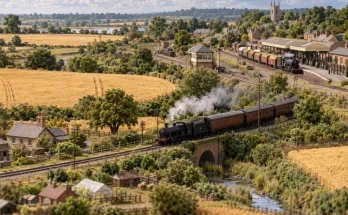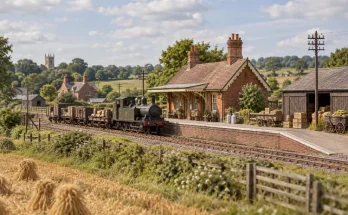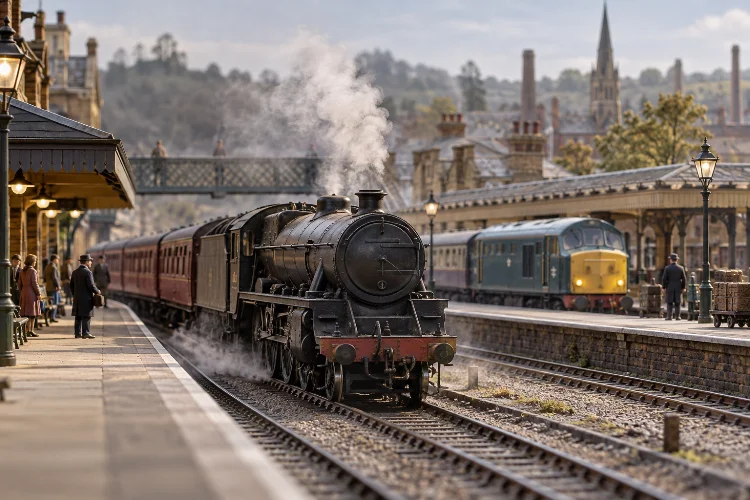
Imagine standing beside a British railway station in the early 1960s. A weathered steam locomotive slowly pulls away from the platform, releasing clouds of smoke into the morning air.
Moments later, a modern diesel train arrives, looking completely different from the traditional engines that dominated Britain’s railways for generations.
It’s a fascinating contrast, isn’t it?
This was one of the most dramatic periods in British railway history. Steam locomotives were gradually disappearing, diesel traction was expanding, and railway infrastructure was undergoing significant changes.
For railway enthusiasts, British Steam and Diesel Transition Modelling for Historic Layouts offers an incredible opportunity to recreate this period of transformation.
Instead of choosing between classic steam engines and early diesel locomotives, you can bring both together in one historically convincing miniature environment.
However, creating an authentic transition-era railway involves more than simply placing different locomotives on the same tracks.
You need to understand regional variations, operating practices, railway architecture, rolling stock, and the historical timeline.
In this guide, we’ll explore how to combine these elements into a realistic British railway layout that captures the character of the 1950s and 1960s.
1. Understanding Britain’s Steam-to-Diesel Railway Transition
The transition from steam to diesel traction didn’t happen overnight.
During the early 1950s, steam locomotives still dominated much of Britain’s railway network. They handled everything from long-distance passenger trains to heavy freight services and local branch-line operations.
However, traditional steam traction required considerable maintenance, coal, water, and specialised labour.
British Railways increasingly recognised the potential advantages of newer locomotive technology.
The Impact of the 1955 Modernisation Plan
The British Transport Commission’s Modernisation and Re-Equipment Plan, published in December 1954 and commonly associated with 1955, marked a major turning point.
The programme proposed substantial investment in diesel and electric traction, improved signalling, new rolling stock, and modern railway infrastructure.
Its estimated investment programme totalled approximately £1.2 billion.
The objective was to make rail transport more competitive against expanding road and air services.
For railway modellers, the consequences were particularly interesting.
Traditional steam locomotives continued operating while newly introduced diesels appeared alongside them. Existing stations, goods yards, and engine sheds increasingly accommodated modern equipment.
The changes weren’t uniform across the country, creating fascinating regional differences.
Why the Transition Period Matters
In March 1960, British Railways completed its final steam locomotive, BR Standard Class 9F No. 92220 Evening Star.
Yet regular steam services continued for several more years.
The famous Fifteen Guinea Special on 11 August 1968 marked the ceremonial end of ordinary British Rail standard-gauge steam operations.
This overlapping period is particularly attractive for historical railway modelling because it combines traditional infrastructure with emerging technology.
A single layout can represent the excitement of modernisation while preserving the familiar atmosphere of Britain’s steam railway heritage.
2. Choosing the Right Year and Region for Your Layout
One of the biggest mistakes in transition-era modelling is treating the entire 1955–1968 period as one interchangeable historical setting.
In reality, railway conditions changed dramatically throughout those thirteen years.
A station modelled in 1957 might look significantly different from the same location in 1967.
Locomotive allocations, station signage, liveries, and infrastructure could all change.
Early Transition: 1955–1960
During the late 1950s, steam traction remained widespread, although diesel shunters and diesel multiple units were becoming increasingly visible.
This makes the period particularly suitable for enthusiasts who want steam locomotives to remain the main attraction.
A typical layout might feature BR Standard steam engines, inherited pre-nationalisation locomotives, and an occasional early diesel working passenger or freight duties.
Traditional goods facilities and steam servicing infrastructure would still be prominent.
Middle Transition: 1961–1964
By the early 1960s, dieselisation was progressing rapidly.
Diesel locomotives increasingly replaced steam on passenger and freight services, while first-generation diesel multiple units became familiar on secondary routes.
This period offers a useful balance between the two forms of traction.
For example, a fictional London Midland Region station set in 1962 could feature a BR Standard steam locomotive, an ex-LMS Black Five, and an early diesel Type 2.
Such combinations should always be checked against the actual locomotive allocations and services of the chosen area.
Late Transition: 1965–1968
The final years were particularly dramatic.
Steam operations had already disappeared from some regions while surviving elsewhere, especially in parts of north-west England.
Meanwhile, British Rail’s new corporate identity, introduced in 1965, gradually brought updated signage and liveries.
For an authenic late-transition setting, choose a specific location where steam genuinely survived.
Otherwise, your layout could accidentally combine equipment that never operated together.
3. Selecting Historically Accurate Steam and Diesel Locomotives
Locomotives are usually the centrepiece of any model railway, and the transition period offers an impressive variety.
However, choosing the right engines requires more than selecting attractive models.
Your locomotive fleet should reflect the geographical region, historical date, and type of railway being represented.
Steam Locomotives That Fit the Period
Several familiar British steam locomotive classes remained operational during the transition years.
The LMS-designed Black Five is particularly useful for layouts representing parts of the London Midland Region.
These versatile locomotives handled passenger and goods services and survived into the final phase of British Rail steam operations.
BR Standard locomotives also provide interesting modelling options.
A Standard Class 4 tank engine can suit certain suburban and regional passenger workings, while larger tender locomotives are more appropriate for heavier main-line duties.
The BR Standard Class 9F offers an imposing option for heavy freight trains, although its suitability depends on the route and service being modelled.
Choose locomotives according to actual historical allocations rather than assuming every famous class appeared everywhere.
Early Diesel Locomotives and Multiple Units
The new generation of British diesel traction included several distinctive designs.
English Electric Type 1 locomotives, later classified as Class 20, and Sulzer-powered Type 2 locomotives, including those later classified as Classes 24 and 25, are useful examples for appropriate routes.
Class 08 diesel shunters are another practical choice for modelling yards and depots.
First-generation diesel multiple units add variety to passenger operations, particularly on branch lines and regional routes.
Western Region layouts offer different possibilities.
That region invested heavily in diesel-hydraulic traction, including the types later known as Hymek, Warship, and Western locomotives.
These geographical differences make locomotive research essential.
Practical tip: Build your fleet around three or four historically compatible locomotives before expanding. A smaller, carefully researched collection often creates a more believable railway than a large assortment of unrelated engines.
4. Getting British Rail Liveries and Rolling Stock Right
Colour schemes are among the first details people notice on a historical railway model.
During the transition period, British Railways introduced several changes to locomotive emblems, passenger coach colours, and eventually its entire corporate identity.
Unfortunately, railway vehicles weren’t repainted simultaneously.
This means historical accuracy depends heavily on the date you select.
Steam Locomotive Liveries
British Railways steam locomotives commonly appeared in black or green liveries, depending on their classification and duties.
Freight and many mixed-traffic engines carried black finishes, while certain passenger locomotives received lined green.
The earlier British Railways lion-and-wheel emblem was gradually replaced by the later crest from the mid-1950s.
However, older markings didn’t disappear immediately.
Photographs from a particular depot or region are invaluable when choosing accurate locomotive identities.
Diesel Green, Maroon Coaches, and Early Rail Blue
Many early main-line diesel locomotives appeared in green liveries.
Passenger coaches could display maroon, Southern Region green, or other period-appropriate finishes, depending on their type, service, and location.
BR Mk1 coaching stock was widespread, but older carriage types also survived.
The introduction of British Rail’s new corporate identity in 1965 added another layer of complexity.
Rail Blue and the famous double-arrow symbol appeared gradually rather than transforming the whole railway overnight.
A layout representing 1966 might therefore legitimately feature an older green diesel beside newer corporate branding, provided the specific combination is historically supported.
Avoiding Incorrect Numbers and Markings
The familiar modern diesel class numbering system wasn’t used in the same way during the 1950s and 1960s.
Many main-line diesel locomotives carried numbers beginning with the letter D, while later TOPS class identities were applied retrospectively when discussing these machines.
For example, a locomotive described today as a Class 24 would have carried a period-appropriate pre-TOPS number during the transition era.
Checking photographs before renumbering a model can prevent surprisingly obvious historical errors.
5. Recreating Steam Sheds and Modern Diesel Depots
Railway infrastructure tells the story of technological change just as clearly as the locomotives themselves.
Steam engines depended on coal supplies, water facilities, ash disposal systems, and frequent mechanical attention.
Diesel locomotives had different servicing requirements.
During the transition period, some facilities were modified, shared, reduced, or eventually closed.
Modelling Traditional Steam Servicing Facilities
A realistic steam servicing area might include a locomotive shed, coaling stage, water tower, ash pit, inspection pits, and associated sidings.
These structures help explain how steam locomotives were prepared for their next duties.
A small branch-line layout may only need a water column and a basic servicing siding.
A large motive-power depot could justify several shed roads and more elaborate equipment.
Weathering should reflect the environment.
Coal dust, ash, soot, and oil stains were common around working steam facilities, although the exact appearance varied according to local maintanance practices.
Introducing Diesel Servicing Infrastructure
Diesel locomotives required fuel storage, inspection facilities, and workshops designed for their mechanical and electrical components.
Diesel fuelling points, storage tanks, pumps, and maintenance buildings can therefore introduce a distinctively modern appearance.
For a mixed-traction setting, consider positioning diesel facilities near older railway buildings.
The contrast between a traditional brick engine shed and a newer industrial workshop can be visually striking.
However, research the actual depot arrangement first.
Not every location received a fully developed diesel servicing installation while steam remained operational.
Some locomotives were serviced at larger depots elsewhere.
6. Designing a Realistic Transition-Era Track Plan
A convincing railway layout doesn’t need a complicated network of junctions and sidings.
What matters most is creating a track arrangement that supports believable railway operations.
For a transition-era setting, the infrastructure should reflect both the railway’s historical origins and changing traffic patterns.
Choosing Between a Main Line and Branch Line
A main-line setting allows you to operate longer passenger trains, powerful locomotives, and more varied freight services.
However, it also requires considerable space if you want realistic train lengths and scenic proportions.
A branch-line model is often more manageable.
A small terminal station with a platform, run-round loop, goods siding, and nearby road access can provide plenty of operational interest.
Diesel multiple units can share the station with occasional locomotive-hauled passenger or freight services where the prototype supports such workings.
Planning a Compact OO Gauge Layout
OO gauge uses a scale of approximately 1:76.2.
A 10-foot-wide scene represents roughly 232 metres of real railway, which demonstrates how quickly space can disappear.
For a compact layout, begin by establishing the main passenger line and the minimum tracks required for realistic operation.
Then add goods-handling facilities and scenic structures.
A fiddle yard can represent the railway network beyond the visible section.
This allows trains to enter and leave the scene without requiring you to model an entire regional railway system.
Avoid inserting unnecessary sidings simply to increase the number of possible movements.
A modest design with sensible operating arrangements can be far more convincing.
7. Creating Authentic 1950s and 1960s Railway Scenery
A transition-era railway needs scenery that reflects the period’s changing social and industrial environment.
During these years, Britain experienced significant changes in road transport, housing, manufacturing, and urban development.
Yet much of the railway system still retained Victorian and Edwardian infrastructure.
This mixture creates a distinctive visual atmosphere.
Combining Old and New Architecture
Traditional brick railway stations, stone bridges, signal boxes, and goods sheds remained common.
Meanwhile, some locations acquired modern signage, industrial buildings, concrete structures, or improved passenger facilities.
Reproducing these contrasts can make a layout particularly engaging.
Imagine a nineteenth-century station building beside a 1960s road vehicle, with a diesel locomotive waiting beneath traditional semaphore signals.
The scene immediately communicates the meeting of two technological generations.
Adding Period-Correct Vehicles and Details
Road vehicles are an effective way to establish the historical date.
A Morris Minor, Austin Cambridge, or period commercial lorry can help evoke the early 1960s.
However, vehicle registration styles, advertisements, street furniture, and clothing should also match the chosen year.
Railway posters, platform benches, luggage trolleys, telephone boxes, and goods-yard equipment provide additional character.
Try using a restrained selection rather than filling every corner with accessories.
Weathering Without Making Everything Look Abandoned
One common modelling mistake is excessive weathering.
Steam locomotives often developed significant grime, while some newer diesels could appear comparatively clean.
However, both types operated in demanding conditions.
Apply subtle differences to individual vehicles based on their age, duties, and maintenance history.
Railway buildings should also show realistic wear.
Faded paint, stained brickwork, and slightly overgrown boundaries create a natural setting without suggesting that every station was already derelict.
8. Recreating Realistic Passenger and Freight Operations
Historical train movements can transform an attractive static layout into a convincing working railway.
During the steam-to-diesel transition, passenger and freight operations changed at different rates.
Diesel multiple units increasingly handled local passenger services, while steam locomotives continued certain freight and secondary duties.
The exact balance varied considerably by region.
Building a Fictional Operating Timetable
Imagine a small London Midland Region station in 1962.
The morning begins with a steam-hauled passenger service arriving from a nearby junction.
Later, a diesel multiple unit brings commuters and shoppers into the town.
During the afternoon, a mixed-traffic steam locomotive arrives with coal wagons and general merchandise.
A diesel shunter at a larger connected yard might be responsible for sorting additional goods wagons.
This scenario is illustrative rather than an actual historical timetable.
Its purpose is to show how different forms of traction can contribute to a coherent operating session.
Modelling Realistic Goods Traffic
Rail freight remained an important part of British railway operations during the transition years.
Coal, agricultural produce, manufactured goods, and industrial materials moved through stations and goods yards across the network.
A realistic freight operation should consider where individual wagons originate and where they’re going.
For example, a mineral wagon might be delivered to a coal merchant while a covered van is collected from a goods shed.
Wagon cards can make operating sessions more engaging.
Each card identifies the vehicle, its contents, and its destination.
This creates a reason for shunting movements instead of simply moving rolling stock around the layout without purpose.
Including Railway Modernisation in Operations
You can also represent operational changes through the types of trains that appear.
An early-transition session might rely heavily on steam.
A later operating sequence could show diesel services taking over particular duties.
If you’re modelling a precise date, though, avoid changing locomotive allocations randomly.
Historical photographs and working timetables are the best guides for recreating genuine traffic patterns.
9. Using Modern Modelling Technology Without Losing Historical Accuracy
Modern railway modelling technology can make transition-era layouts more immersive than ever.
Digital Command Control, realistic sound systems, improved lighting, and precision-manufactured models allow enthusiasts to reproduce convincing railway movements.
However, technology should support historical realism rather than overwhelm it.
DCC Sound for Steam and Diesel Locomotives
DCC sound decoders can reproduce steam exhaust beats, whistles, diesel engine acceleration, and other operational sounds.
The contrast between these sound profiles is particularly effective on a mixed-traction layout.
Steam locomotives may produce exhaust rhythms that respond to speed and load, while diesel models can simulate engine idling and changes in power.
Choose sound projects designed for the locomotive being represented.
An inappropriate horn or engine recording can weaken the effect of an otherwise carefully detailed model.
Realistic Lighting and Movement
Locomotive lamps and headcodes deserve careful attention.
British locomotives displayed different lamp arrangements and train identification systems depending on the period, route, and vehicle type.
Avoid using generic modern lighting configurations on historical stock.
Similarly, smooth acceleration, slow-speed shunting, and realistic stopping distances can make operations feel more convincing.
Before adding complicated electronics, ensure your locomotives have reliable electrical pickup and that the track is correctly installed.
A beautifully detailed railway isn’t much fun when trains repeatedly stall.
10. Researching Historical Details and Avoiding Common Mistakes
The difference between a good transition-era layout and an outstanding one often comes down to research.
Historical accuracy requires attention to seemingly minor details.
A particular locomotive may have been withdrawn before your chosen year, while a station might have lost its passenger services earlier than expected.
Even railway signs and goods-yard facilities can reveal chronological inconsistencies.
Building a Research Collection
Start with historical photographs, locomotive allocation records, railway maps, and working timetables.
The National Railway Museum and Science Museum Group collections provide valuable material about Britain’s railway development.
The Railways Archive is particularly useful for understanding modernisation policies and infrastructure changes.
Railway enthusiast societies, preservation groups, and specialist publications can supply additional regional information.
Keep reference images organised seperately by year and location.
This makes it easier to compare architectural features, liveries, rolling stock, and station arrangements.
Common Mistakes Worth Avoiding
The most frequent problem is mixing locomotives from incompatible regions or dates.
Another involves combining late-1960s corporate branding with railway equipment that had already disappeared from a particular location.
Oversized steam depots, excessive sidings, and inappropriate passenger coaches can also reduce realism.
Before purchasing a new model, ask whether it actually belongs in your intended historical setting.
It’s also worth remembering that the transition period wasn’t simply a straightforward story of progress.
Some early diesel designs proved unreliable, regional policies differed, and railway closures significantly changed local communities.
Including these historical realities adds depth to your layout.
A carefully researched model captures not only the appearance of railway modernisation but also the complicated transformation behind it.
British Steam and Diesel Transition Modelling for Historic Layouts brings together two remarkable chapters of railway history.
The combination of traditional steam locomotives, early diesel traction, changing infrastructure, and distinctive railway architecture creates endless possibilities for engaging historical layouts.
However, realism depends on careful choices.
Selecting the right year, researching regional locomotive allocations, matching liveries, and recreating believable operations can turn an ordinary model railway into a convincing miniature representation of Britain’s railway transformation.
You don’t need an enormous collection of locomotives or an elaborate track network to achieve impressive results.
Start with a manageable location, choose a specific year, and develop your layout around documented historical evidence.
Ready to recreate the golden years of British railway transition? Choose your favourite region, plan your first mixed-traction operating session, and bring this unforgettable railway era back to life.