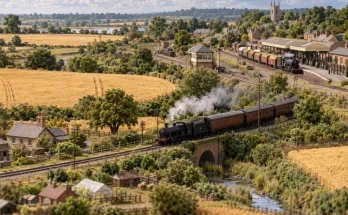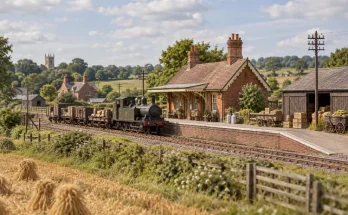
There’s something incredibly satisfying about watching a beautifully detailed British steam locomotive roll into a miniature countryside station. The platform looks weathered, the signal box feels authentic, and every wagon seems like it belongs exactly where it is.
But here’s the interesting part: creating that level of realism isn’t just about buying expensive models or mastering scenic techniques.
It’s about understanding history.
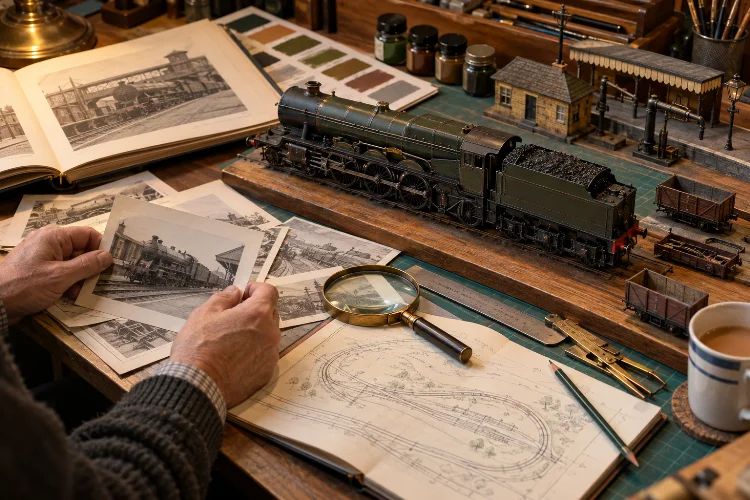
Advanced British railway era research for authentic model layouts helps enthusiasts recreate the actual appearance, atmosphere, and daily operations of Britain’s railway network during specific historical periods.
From Victorian branch lines and the famous Big Four companies to British Railways steam operations and early dieselisation, every era has its own fascinating characteristics.
And those differences matter more than you might think.
A locomotive wearing the wrong livery, a signal box built decades too late, or an unrealistic goods train can easily disrupt an otherwise convincing scene.
Fortunately, researching historical railways has become much easier thanks to digital archives, old maps, photographic collections, and specialist railway societies.
In this guide, we’ll explore how to turn historical evidence into accurate, engaging model railway layouts that genuinely capture Britain’s railway heritage.
1. Understanding British Railway Eras Before Planning Your Layout
Before designing a single stretch of track, you need to answer one important question: when exactly does your railway exist?
It sounds straightforward, but British railway history is full of overlapping technologies, changing ownership, and regional differences.
Choosing an era provides the historical foundation for everything that follows, including locomotives, rolling stock, buildings, signalling equipment, and operating procedures.
The Major Periods of British Railway History
Britain’s railway development can be divided into several broad historical periods.
The Victorian and Edwardian period, before 1923, featured numerous independent railway companies, each developing its own locomotives, architectural styles, passenger services, and operating traditions.
Companies such as the Great Eastern Railway, Midland Railway, Great Western Railway, and London and South Western Railway maintained distinctive identities.
This makes pre-grouping railway modelling particularly interesting, although accurate reproduction can demand considerable reasearch and custom modelling.
The Grouping period, 1923–1947, introduced the famous Big Four railway companies: the Great Western Railway (GWR), London, Midland and Scottish Railway (LMS), London and North Eastern Railway (LNER), and Southern Railway (SR).
Although these companies inherited enormous amounts of older equipment, they gradually developed increasingly recognisable locomotive designs, passenger stock, and corporate identities.
The British Railways period, beginning in 1948, brought nationalisation and another major transformation.
Early nationalisation layouts are especially attractive because older company infrastructure and rolling stock often remained in service alongside new British Railways designs.
Later decades introduced widespread dieselisation, electrification, infrastructure rationalisation, and major changes to freight operations.
Why Specific Dates Matter More Than Broad Era Labels
Commercial model manufacturers frequently use numbered railway eras to categorise their products.
These labels are useful starting points, but they shouldn’t replace detailed historical investigation.
For example, a layout representing 1952 might feature locomotives carrying different liveries because repainting programmes took time.
Meanwhile, a supposedly typical 1960s railway could look radically different depending on whether it represents 1961 or 1969.
A practical approach is to select a narrow modelling window, perhaps three to five years, and investigate which equipment genuinely operated during that period.
This gives your miniature railway a much stronger historical identity.
2. Researching Regional Railway History and Local Characteristics
One of the biggest mistakes in historical railway modelling is assuming Britain’s railway network looked the same everywhere.
In reality, railway infrastructure developed around local geography, industries, population patterns, and the engineering preferences of individual companies.
A rural Norfolk branch line had very different requirements from an industrial railway in South Wales or a busy suburban route near London.
Understanding these differences makes your layout feel like a real place rather than a collection of attractive railway accessories.
Choosing a Region With a Clear Railway Identity
Start by selecting a geographical area that interests you.
Perhaps you’re fascinated by the countryside railways of Suffolk, the industrial valleys of Yorkshire, the Scottish Highlands, or the coastal routes of Cornwall.
Each setting brings its own modelling opportunities.
An East Anglian branch line might feature relatively flat landscapes, modest station buildings, agricultural goods traffic, and surviving Great Eastern Railway structures.
A railway serving a Welsh coalfield could require mineral wagons, industrial sidings, steep terrain, and facilities associated with local mining operations.
These characteristics influence not only scenery but also the types of trains that would realistically use the line.
Investigating Local Industries and Traffic Patterns
Railways existed primarily to move passengers and goods, so understanding local economic activity is essential.
Look for historical information about farms, factories, breweries, ports, quarries, cattle markets, and warehouses near your chosen station.
A small agricultural community might generate seasonal produce traffic, coal deliveries, livestock movements, and general merchandise.
By contrast, a railway connected to a steelworks would require a completely different range of wagons and operating arrangements.
Historical company records, trade directories, local newspapers, and railway goods documentation can reveal useful information.
The National Archives provides research guidance covering railway company records, administrative documents, accident reports, and other surviving material.
One valuable technique is to create a short historical profile of your chosen location, identifying its major industries, railway ownership, and typical traffic during your selected period.
That profile becomes the foundation for the trains and operating sessions you eventually create.
3. Using Historic Maps and Track Plans to Reconstruct Real Railways
Old maps are among the most powerful tools available to railway modellers.
They reveal infrastructure that photographs sometimes miss, including hidden sidings, loading docks, access roads, railway boundaries, and industrial connections.
More importantly, they help explain how a station actually functioned.
A beautiful station building might attract your attention, but the surrounding track arrangement determines how trains moved through the location.
Finding Reliable Historical Railway Maps
The National Library of Scotland offers an extensive digital map collection that includes historical Ordnance Survey mapping for England, Scotland, and Wales.
Its georeferenced mapping tools allow researchers to compare historical maps with more modern geographical information.
This makes it easier to identify former railway alignments and understand how surrounding landscapes have changed.
For a rural station, begin with a historical map covering your chosen decade or the closest available survey period.
Look carefully at the main running lines, goods sidings, engine facilities, platform arrangements, and nearby roads.
Pay attention to map survey and revision dates. A map published in one year may represent information collected several years earlier.
Understanding Track Layout Development
Railway track arrangements were rarely completely static.
Additional sidings could appear when local industries expanded, while older facilities might disappear following changes in traffic or operating requirements.
A station that featured several goods sidings in 1910 might have a much simpler arrangement by the late 1960s.
Comparing maps from different decades allows you to identify these changes.
This becomes particularly important when researching the transition from steam to diesel traction, because locomotive servicing requirements changed significantly.
You should also distinguish railway infrastructure from nearby industrial tracks that may have belonged to private operators.
Translating Real Track Plans Into Model Scale
Once you’ve found a suitable prototype, the next challenge is fitting it into your available space.
A real railway station can occupy hundreds of metres, making literal reproduction impractical for many home layouts.
In OO gauge, using the common British scale of 1:76.2, a real-world distance of 100 metres corresponds to approximately 1.31 metres on the model.
That means even a modest prototype can require considerable room.
The solution is selective compression, where less important distances are shortened while essential operational relationships are preserved.
For example, you might reduce the length of a goods yard but retain the correct relationship between the platform, run-round loop, and loading siding.
The goal isn’t simply to copy every measurement. It’s to preserve the railway’s recognisable structure and working logic.
4. Analysing Historical Photographs and Railway Architecture
Historical photographs can transform a technically accurate track plan into a convincing miniature environment.
They reveal the details that maps cannot: platform surfaces, fencing styles, roof materials, advertising boards, vegetation, and the general condition of railway buildings.
Even apparently ordinary photographs can contain remarkably useful information.
A picture taken to capture a locomotive may accidentally document the exact arrangement of a station canopy, signal post, or goods loading area.
Building a Photographic Reference Collection
The Science Museum Group’s online collection is a valuable starting point for researching historical railway objects, photographs, documents, and related material.
Specialist photographic archives, preservation groups, railway publications, and local history collections can provide additional evidence.
When searching, use combinations of location names, railway companies, approximate dates, and infrastructure terms.
For instance, searching for a station name alongside phrases such as “goods yard,” “signal box,” or “1950s railway” may reveal useful material.
Save the source information for each photograph, including its stated date and any uncertainty about that date.
A photograph from 1975 shouldn’t automatically be treated as evidence of how the same location appeared in 1935.
Reading Architectural Details Correctly
British railway companies developed distinctive architectural traditions.
Building materials, roof designs, window arrangements, platform canopies, and decorative features could vary considerably between companies and regions.
Historic England’s research into railway structures provides useful guidance for understanding these differences.
Signal boxes are particularly revealing because their designs often reflect both company traditions and signalling technology.
Historic England reports that Britain still had more than 10,000 mechanical signal boxes in 1948, with that number falling to around 4,000 by 1970.
This demonstrates how dramatically railway infrastructure changed during the twentieth century.
Recreating Weathering and Everyday Atmosphere
Historical accuracy also involves understanding how railway structures aged.
A busy steam-era locomotive depot might display soot-stained brickwork, oily surfaces, and heavily worn track areas.
A quiet rural station could have cleaner buildings but weathered fencing, uneven vegetation, and ageing goods facilities.
Photographs help distinguish believable wear from exaggerated weathering.
Remember that a working railway was maintained for safety and practical operation. Not every building should look abandoned, even during periods of economic decline.
Subtle details usually create a more convincing result than covering everything in rust and grime.
5. Matching Locomotives, Rolling Stock, and Liveries to Your Era
Choosing historically appropriate locomotives is one of the most enjoyable parts of building a British model railway.
It’s also an area where seemingly minor inaccuracies can quickly become obvious.
A locomotive might be mechanically suitable for your chosen period but carry a number, tender configuration, or livery that didn’t exist at the time.
The challenge becomes even more interesting when you consider regional allocations.
Researching Locomotive Allocations and Service Histories
Start by identifying the locomotive classes associated with your selected railway company or region.
Then investigate whether particular examples operated near your chosen location during the relevant years.
Railway enthusiasts frequently focus on locomotive class introductions and withdrawals, but individual engine histories are equally important.
A locomotive class might exist nationally for several decades while specific members were transferred between depots, rebuilt, renumbered, or withdrawn.
Historical allocation records, locomotive registers, photographic evidence, and specialist class histories can help establish these details.
If you’re recreating a 1950s former Great Eastern Railway branch, for example, research which inherited steam classes remained locally available and whether newer traction had actually appeared.
Avoid assuming that every nationally available locomotive could realistically visit every branch line.
Understanding Transitional Liveries
Railway liveries didn’t change overnight.
Following the 1923 Grouping and the 1948 nationalisation, older paint schemes often remained visible while stock was gradually repainted.
That creates fascinating opportunities for authentic mixed-livery trains.
However, combinations still need to reflect a believable date.
A locomotive carrying a particular crest, numbering style, or regional marking might indicate a narrower timeframe than its basic class history suggests.
Check photographic evidence whenever possible, especially when modelling transitional periods.
Researching Coaches and Freight Wagons
Passenger coaches and goods wagons deserve the same attention as locomotives.
Consider carriage design, braking systems, coupling arrangements, train formations, and operating duties.
For goods traffic, investigate whether your chosen railway handled coal, agricultural produce, livestock, general merchandise, or specialised industrial materials.
Wagon variety should emerge from those traffic requirements rather than simply from whatever models are available.
This is also where occasional compromises are reasonable. If a precise vehicle isn’t commercially available, a carefully modified kit or closely related prototype may provide a better solution than an obviously unsuitable substitute.
6. Recreating Authentic Railway Operations With Historical Timetables
A historically accurate railway layout should do more than look convincing.
It should behave like a railway from its chosen period.
That means understanding train frequencies, stopping patterns, goods services, shunting arrangements, and the operational limitations of the infrastructure.
This is where advanced historical research becomes especially rewarding.
Working Timetables Versus Public Timetables
Public passenger timetables show the services intended for travellers.
Working timetables provide operational information used by railway staff, making them particularly valuable for model railway research.
They can help establish passenger train movements, freight schedules, timings, and relationships between different services.
The Railway Correspondence & Travel Society maintains significant collections of working timetables, traffic notices, rule books, and operating instructions.
Its holdings include separate collections for material before 1970 and after 1969.
Access arrangements vary, so researchers may need to consult catalogue information or contact the collection custodians.
Designing a Realistic Operating Session
Imagine you’re modelling a fictional rural branch inspired by eastern England in the mid-1950s.
Your timetable might include a morning passenger arrival, a mixed goods working serving local sidings, another passenger service later in the day, and limited evening traffic.
These would be illustrative possibilities rather than a verified timetable for a particular location.
The actual frequencies must be established through period documents if you want prototype accuracy.
Once you understand the service pattern, convert it into a manageable model operating session.
A timetable representing several hours of real railway activity might be compressed into a shorter running session, provided movements remain logically consistent.
Modelling Goods Yard Procedures
Goods operations offer excellent opportunities to make layouts more interactive.
Instead of running a goods train around the circuit, assign wagons to individual destinations.
A coal merchant might recieve loaded coal wagons, while a local agricultural warehouse dispatches produce or takes deliveries of supplies.
The locomotive must then position wagons at the appropriate sidings while respecting track capacity and signalling restrictions.
This encourages purposeful shunting rather than random wagon movements.
You can also create simple wagon cards showing each vehicle’s origin, destination, and load.
That small addition turns a basic layout into a miniature transport system with its own operating challenges.
7. Researching Signalling and Turning Historical Evidence Into a Layout
Signalling is one of the most technically demanding aspects of authentic British railway modelling.
It’s tempting to install attractive semaphore signals wherever they look good, but real signalling arrangements followed operational requirements.
The position and purpose of each signal depended on the track layout, direction of travel, junction arrangements, and methods of controlling train movements.
Understanding those relationships makes a layout both more realistic and more interesting to operate.
Finding Historical Signalling Diagrams
The Signalling Record Society maintains specialist resources covering railway signalling, operating instructions, historical diagrams, and related documents.
Its archive catalogue includes signalling diagrams, maps, plans, rule books, and official notices.
These sources can help identify where signals were located and how railway layouts changed over time.
For mechanical signalling, investigate the relationship between semaphore signals, point controls, lever frames, and block-working arrangements.
Some single-line railways used physical tokens or staffs to control access to sections of track, while others employed different approved systems.
You shouldn’t automatically apply one signalling method to every branch line.
Building a Historical Evidence Checklist
Before permanently installing track and structures, assess the strength of your historical evidence.
I recommend organising your research into three simple categories:
- Confirmed details: Supported by dated photographs, contemporary maps, diagrams, or official records.
- Probable details: Consistent with documented company practices and comparable local examples.
- Creative assumptions: Reasonable additions made because complete historical evidence is unavailable.
This method helps prevent guesses from gradually becoming accepted as historical facts.
It also makes future revisions easier when new photographs or plans emerge.
For larger layouts, keep a seperate research folder for track plans, rolling stock, architecture, signalling, and operating documents.
Balancing Authenticity With Practical Modelling
Perfect historical reconstruction isn’t always possible.
Some railway records have disappeared, some photographs lack accurate dates, and certain structures were altered repeatedly.
Meanwhile, most modellers face limitations involving space, money, and available products.
Rather than treating these constraints as failures, decide which historical features are essential to your project’s identity.
A distinctive station building, correct track arrangement, suitable locomotive allocation, and believable goods operation often contribute more to authenticity than dozens of tiny decorative details.
For example, preserving the correct function of a run-round loop is generally more valuable than reproducing every metre of surrounding countryside.
Likewise, a carefully researched station sign can communicate a specific period more effectively than several unrelated scenic accessories.
Creating a Consistent Historical Environment
The final stage is making sure every element belongs to the same miniature world.
Examine road vehicles, clothing, advertising, telephone equipment, railway fencing, station furniture, and nearby buildings.
These details can reveal chronological inconsistencies that wouldn’t be obvious when looking only at the trains.
A 1930s layout shouldn’t casually include street furniture introduced several decades later.
Similarly, modern infrastructure features may look out of place on an otherwise convincing early British Railways scene.
Try photographing your completed sections in black and white.
This removes distracting colours and makes it easier to compare the arrangement, proportions, and atmosphere with historical reference photographs.
More importantly, keep revisiting your research as the layout develops.
New discoveries can improve building placement, rolling stock selections, and operational arrangements without requiring you to rebuild the entire railway.
Historical modelling is an evolving process, and there’s always something interesting left to discover.
Advanced British railway era research transforms model railway building from a purely creative hobby into a fascinating exploration of Britain’s transport history.
By studying historical maps, regional industries, photographs, locomotive records, working timetables, and signalling diagrams, you can develop a layout that looks authentic and operates convincingly.
The secret isn’t reproducing every historical detail perfectly. It’s understanding which features define your chosen railway, location, and period.
Start with one station, select a specific date, and gather reliable evidence before making major modelling decisions. Build your miniature railway around what you’ve discovered, allowing practical compromises where necessary.
Ready to create a more authentic British model railway? Choose your favourite historical era, explore the archives, and start turning real railway history into a detailed miniature world worth sharing.