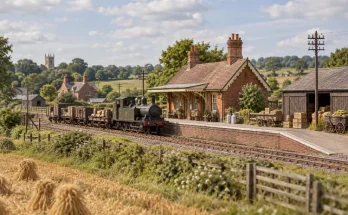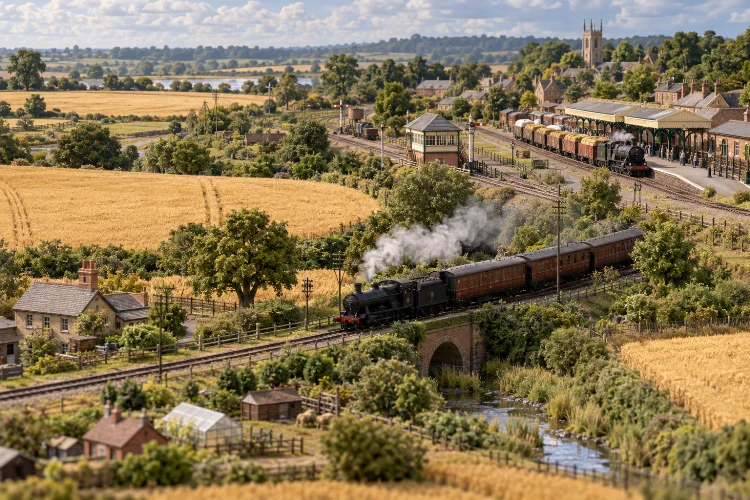
Imagine a small steam locomotive slowly crossing the Suffolk countryside, passing golden wheat fields, quiet villages, and traditional railway signal boxes.
A few miles away, another train carries agricultural goods toward a busy market town, while passengers wait beneath the modest canopy of a rural station.
These scenes once formed part of everyday life across East Anglia.
Today, many of those historic railway routes have disappeared, leaving behind abandoned station buildings, converted trackbeds, and fascinating stories of Britain’s railway past.
But what if you could bring them back?
Reconstructing East Anglian railway networks through scale models offers railway enthusiasts an opportunity to recreate the region’s transport history in miniature.
From the extensive Great Eastern Railway system to the charming Mid-Suffolk Light Railway and the Midland & Great Northern Joint Railway, East Anglia provides remarkable inspiration for historically accurate layouts.
And you don’t need an enormous room or unlimited budget to get started.
With thoughtful research, suitable modelling techniques, and a little creativity, even a compact railway layout can capture the atmosphere of Norfolk, Suffolk, Cambridgeshire, and Essex during the golden age of British railways.
1. Understanding the History of East Anglian Railway Networks
Before laying a single piece of track, it’s worth understanding why East Anglia developed such an interesting railway network.
Unlike the heavily industrialised regions of northern England, much of East Anglia depended on agriculture, coastal trade, market towns, and connections to London.
Railways became essential for moving people, agricultural products, coal, livestock, and manufactured goods between these communities.
The Great Eastern Railway’s Regional Influence
The Great Eastern Railway (GER), established in 1862, became one of the most influential railway companies in eastern England.
Its network connected London with important regional centres, including Cambridge, Ipswich, Norwich, and numerous smaller towns.
The company also operated an extensive collection of branch lines serving communities that might otherwise have remained relatively isolated.
These rural routes are particularly appealing to railway modellers because they often featured modest stations, short trains, goods sidings, and relatively uncomplicated track arrangements.
In 1923, the GER became part of the London and North Eastern Railway (LNER) under Britain’s railway grouping.
The network later entered British Railways ownership following nationalisation in 1948.
Each historical period offers different modelling opportunities, from GER locomotives and station architecture to later steam and diesel operations.
The Midland & Great Northern Joint Railway
The Midland & Great Northern Joint Railway (M&GN) provided another important network across Norfolk and neighbouring areas.
Established as a joint railway in 1893, it linked East Anglian destinations with the Midlands and offered alternative routes to coastal holiday resorts.
At its greatest extent, the system covered approximately 186 route miles.
Much of the network consisted of single-track railway with passing loops at selected stations.
That operating arrangement makes it especially interesting for scale modelling.
Unfortunately, most of the M&GN system closed on 28 February 1959, although parts survived longer.
Today, the North Norfolk Railway preserves an important section of the region’s railway heritage.
2. Choosing the Right Historical Period and Railway Route
One of the biggest decisions in historical railway modelling is selecting exactly what to recreate.
East Anglia’s railway system changed significantly between the Victorian era and the second half of the twentieth century.
Trying to represent every period simultaneously can create historical inconsistencies.
Select a Specific Railway Era
A late Victorian layout might feature ornate station architecture, early steam locomotives, and traditional goods facilities.
An LNER-era layout from the 1930s could combine established branch-line services with increasingly important agricultural freight traffic.
Meanwhile, a 1950s British Railways setting offers a fascinating mixture of inherited steam locomotives, changing railway liveries, and the early stages of modernisation.
Choose a particular year or narrow time period before purchasing locomotives and rolling stock.
This makes it easier to research accurate train formations, station signs, infrastructure, and operating procedures.
Find Inspiration in Real East Anglian Routes
The region offers several attractive modelling possibilities.
The Mid-Suffolk Light Railway, often called the “Middy,” is particularly suitable for enthusiasts who enjoy modest rural stations.
Its operational route ran between Haughley and Laxfield, serving agricultural communities in central Suffolk.
Although originally intended to become a larger network, financial difficulties prevented much of the planned construction.
Goods services began in 1904, passenger services followed in 1908, and the line finally closed in 1952.
Another option is the former M&GN route through Sheringham and Weybourne, where coastal scenery adds an entirely different atmosphere.
Alternatively, a fictional station inspired by several genuine locations allows greater design flexibility while maintaining historical credibility.
3. Researching Historic Railway Maps, Stations, and Infrastructure
A convincing reconstruction begins with reliable historical research.
Fortunately, many original railway maps, photographs, station diagrams, and operational documents remain accessible.
These resources help modellers distinguish genuine historical details from attractive but inaccurate assumptions.
Using Historical Ordnance Survey Maps
Old Ordnance Survey maps are among the most useful resources for railway layout planning.
They can reveal track arrangements, platform positions, goods yards, signal boxes, bridges, and nearby buildings.
The National Library of Scotland provides online access to extensive collections of historical maps covering England and Wales.
Its georeferenced mapping tools allow researchers to compare historical railway infrastructure with modern geography.
For example, you might locate a former Suffolk branch-line station and identify where its goods siding once connected with the running line.
Comparing maps from different decades can also reveal how the station changed over time.
Some sidings were extended, platforms modified, or goods facilities removed as traffic patterns evolved.
These changes matter when recreating a particular period.
Study Historic Railway Photographs
Photographs provide details that maps often overlook.
Station nameboards, platform lamps, fencing, signal posts, telegraph poles, and building materials all contribute to the appearance of a railway.
Look carefully at the surrounding landscape too.
A photograph might reveal a village road beside the station, a coal merchant’s yard, or agricultural buildings beyond the tracks.
These small features help create a convincing sense of place.
Museums such as the East Anglian Railway Museum at Chappel and Wakes Colne are useful for studying surviving railway infrastructure.
The preserved goods shed, station buildings, and signalling equipment offer valuable visual references for historical modellers.
4. Designing Realistic East Anglian Railway Layouts
Once you’ve selected a route and gathered historical references, the next step is turning that information into a practical track plan.
The challenge is balancing historical accuracy with available modelling space.
A real railway station could stretch across several hundred metres, making a completely accurate miniature reproduction impractical for many enthusiasts.
Choosing Between OO, N, and O Gauge
OO gauge remains particularly popular among British railway modellers.
At approximately 1:76 scale, it provides a comfortable balance between visible detail, locomotive availability, and manageable layout dimensions.
British N gauge uses approximately 1:148 scale, making it attractive for longer rural railway scenes.
For perspective, a 100-metre section of real railway would measure approximately 1.32 metres in OO scale but only around 68 centimetres in British N gauge.
That difference becomes significant when modelling stations, passing loops, and countryside.
O gauge, at approximately 1:43.5 scale in British practice, offers greater opportunities for detailed locomotives and buildings but demands considerably more room.
The right scale depends on whether you prefer intricate individual scenes or a broader representation of an entire railway route.
Recreating a Typical Rural Station
A compact East Anglian station might include a single passenger platform, a passing loop where appropriate, and a short goods siding.
Larger stations could feature cattle docks, goods sheds, coal merchants, and additional sidings.
However, every piece of track should have a believable operational purpose.
Avoid filling the layout with unnecessary points simply because there’s space available.
On a branch-line terminus, a run-round loop can be essential for conventional locomotive-hauled trains.
A hidden fiddle yard can represent distant locations such as Ipswich, Norwich, or a main-line junction without physically constructing the entire network.
Applying Selective Compression
Selective compression means shortening real distances while retaining the most recognisable features of the original railway.
For instance, a lengthy station approach might be reduced while preserving the platform building, goods yard, and distinctive track arrangement.
This approach allows a relatively small layout to convey the character of a much larger location.
The trick is preserving realistic proportions.
Overly short platforms, impossibly sharp curves, and crowded buildings can quickly destroy the impression of a working railway.
5. Modelling Authentic East Anglian Locomotives and Rolling Stock
Locomotives are often the first things people notice on a model railway.
But choosing historically appropriate engines requires more than finding an attractive steam locomotive.
East Anglian railway operations used different locomotive classes depending on the route, traffic, and historical period.
Great Eastern Railway Locomotives
The GER developed numerous locomotive designs suited to its regional network.
The GER Y14 class, later classified as J15 by the LNER, became especially associated with freight and rural railway work.
These 0-6-0 tender locomotives were well suited to many secondary duties.
GER-designed J69 0-6-0 tank locomotives also performed useful shunting and local railway work, although their suitability for a particular layout depends on historical allocation records.
For a 1930s East Anglian branch line, an appropriate J15 hauling a short mixed goods train could create an extremely convincing scene.
However, locomotive availability varied between routes and decades.
Research actual allocations before deciding that a particular engine belongs on your chosen railway.
Passenger Coaches and Freight Wagons
Rolling stock deserves just as much attention as locomotives.
A lightly used rural passenger service might require only a few coaches, while more heavily travelled routes could justify longer formations.
Goods vehicles should reflect the local economy.
Open wagons, covered vans, cattle wagons, coal wagons, and agricultural freight vehicles were important components of traditional railway operations.
Weathering should remain subtle and varied.
Some vehicles might show considerable wear, while others would appear relatively clean following repairs or repainting.
Matching rolling stock to its intended duties helps the entire model railway feel more authentic.
6. Recreating Agriculture and Rural Freight Operations
Agricultural traffic is one of the defining features of historic East Anglian railway modelling.
The region’s fertile farmland produced substantial quantities of grain, vegetables, sugar beet, and other agricultural commodities.
Railways transported these products to markets, factories, and distribution centres.
Why Goods Traffic Matters
The Mid-Suffolk Light Railway provides a particularly interesting historical example.
According to the railway’s museum, goods traffic accounted for approximately 80% of its revenue during the final six months before its takeover by the LNER in 1924.
That figure illustrates how important freight could be to a seemingly quiet country railway.
Coal was a major incoming commodity, while grain, livestock, and agricultural produce generated outward traffic.
Sugar beet became increasingly important from the late 1920s.
In 1934, the Middy carried approximately 21,000 tons of sugar beet to factories at Bury St Edmunds, Ipswich, and Cantley.
These historical details provide excellent inspiration for realistic operating sessions.
Building a Functional Goods Yard
Imagine a fictional Suffolk station receiving three coal wagons and two covered vans.
The coal wagons must be positioned beside the local merchant’s yard, while the vans are delivered to the goods shed.
Meanwhile, an empty wagon is waiting for collection.
The locomotive must carefully organise these movements before returning to the junction.
Using wagon cards or waybills adds another level of realism.
Each wagon receives an assigned destination, cargo, and collection instruction.
A covered van might recieve a shipment of bagged barley for a brewery, while another wagon waits for agricultural machinery.
This transforms shunting from repetitive movement into a meaningful operating challenge.
7. Recreating Signalling and Historic Railway Operations
A railway layout becomes much more engaging when trains operate according to realistic procedures.
Historically, railway staff coordinated movements using timetables, signal boxes, block instruments, and various operating regulations.
These systems were especially important on single-track routes.
Traditional Semaphore Signalling
Semaphore signals were a familiar feature of British railway networks for many decades.
They communicated instructions using movable arms and coloured lights.
However, signal types and arrangements varied according to railway company, location, and historical period.
Rather than installing signals randomly, study actual station signalling diagrams where available.
A modest branch-line station might have only a small number of signals and manually operated points.
The correct arrangement often looks more convincing than an unnecessarily complicated signal installation.
Timetables and Single-Line Working
Single-track railway operations required careful coordination to prevent opposing trains entering the same section.
Historical systems included train staff, staff-and-ticket, and electric token working.
A model railway can reproduce these principles using simple physical tokens and operating instructions.
For example, an operator must obtain the correct token before moving a train into a designated single-line section.
A timetable can then coordinate passenger services with pick-up goods trains.
You might schedule a morning passenger arrival, a midday freight working, and an afternoon return service.
Occassionally introducing a delayed train or additional goods movement can make the session more interesting.
The objective isn’t to make operations unnecessarily complicated.
It’s to recreate the decisions that real railway staff faced during an ordinary working day.
8. Capturing East Anglia’s Distinctive Landscape and Architecture
One of the biggest advantages of modelling East Anglia is the region’s recognisable scenery.
Its landscapes include open farmland, wetlands, coastal villages, rivers, market towns, and gently rolling countryside.
These surroundings give East Anglian railway layouts a character quite different from industrial or mountainous railway settings.
Recreating the Countryside
A Norfolk or Suffolk layout doesn’t necessarily need dramatic hills or deep railway cuttings.
Wide fields, hedgerows, country lanes, drainage channels, and distant church towers can create a much stronger regional identity.
In the Fens, long views across low-lying farmland are particularly characteristic.
Elsewhere, such as parts of north Norfolk, the landscape becomes more undulating.
Choosing the right scenery for your specific route is therefore essential.
Avoid assuming that every location in East Anglia is completely flat.
Modelling Traditional Railway Buildings
Historic station architecture can help establish the railway company and period.
Brick stations, timber structures, goods sheds, loading docks, and traditional signal boxes are useful features to research.
On the Mid-Suffolk Light Railway, modest timber-and-iron station buildings reflected the railway’s limited resources.
The preserved railway museum at Brockford includes original structures that provide valuable modelling inspiration.
For a larger GER station, brickwork, decorative details, and more substantial platform buildings might be appropriate.
Pay attention to road vehicles, advertising signs, fencing, and rural businesses surrounding the station.
These details establish the historical setting without requiring excessive scenery.
9. Example: Building a Fictional Suffolk Railway Network in 1934
To understand how these ideas work together, consider a fictional layout inspired by central Suffolk’s rural railways.
Let’s call the location West Barham, a small agricultural junction imagined as part of a wider LNER network.
The chosen year is 1934, allowing the layout to feature traditional steam operations and important seasonal agricultural traffic.
Planning the Layout
West Barham has one passenger platform, a run-round loop, a goods shed siding, and a separate coal merchant’s siding.
A small loading area handles agricultural produce during harvest periods.
A hidden fiddle yard represents connections to larger railway centres.
Although the setting is fictional, its infrastructure and traffic patterns draw inspiration from historical Suffolk railway practices.
This distinction is useful because it allows operational flexibility without pretending that an invented station is historically documented.
Creating a Typical Operating Session
The morning begins with a short passenger train arriving from the junction.
After the passengers depart, the locomotive prepares for the return journey.
Later, a J15 locomotive arrives with a small goods train carrying coal, general merchandise, and agricultural supplies.
The operator must seperate incoming wagons, collect empty vehicles, and organise the departing train.
During the autumn harvest, additional open wagons are required for sugar beet traffic.
These extra movements create operational variety without adding unnecessary tracks.
A complete session might represent several hours of railway activity compressed into approximately one hour of real modelling time.
Making the Network Feel Larger
Even a compact layout can suggest an extensive railway system.
Train destination cards, imagined off-scene junctions, and realistic timetables create connections to places beyond the visible station.
The surrounding scenery reinforces that illusion.
A country road disappearing behind trees, telegraph wires continuing toward the horizon, and a railway line curving behind buildings all suggest a much larger world.
The model doesn’t need to display every mile of railway.
It simply needs to make viewers believe those miles exist.
10. Common Mistakes and How to Improve Historical Accuracy
One common mistake is mixing railway periods without checking whether the locomotives, rolling stock, and infrastructure belong together.
Another involves creating stations with far more track than their real-world counterparts would have required.
Historical rural railways were often relatively simple installations.
Overcomplicated layouts can look unrealistic and create unnecessary operating problems.
Scenery is another area where modellers sometimes struggle.
Generic hills, unsuitable buildings, or inappropriate industries can make an East Anglian railway feel more like somewhere else in Britain.
Research photographs of the exact area you’re modelling.
Finally, don’t overlook practical maintenence.
Reliable trackwork, smooth locomotive performance, and accessible points are essential for enjoyable operating sessions.
Test the track arrangement before permanently installing scenery.
Small improvements to operational reliability can make a greater difference than expensive decorative additions.
Reconstructing East Anglian railway networks through scale models offers a fascinating way to preserve and explore Britain’s regional railway history.
From the Great Eastern Railway’s extensive routes to the agricultural branch lines of Suffolk and the coastal connections of Norfolk, the region provides an incredible variety of modelling possibilities.
The most convincing layouts combine historical research, appropriate locomotives, practical track arrangements, and realistic railway operations.
Accurate scenery and carefully selected buildings add the finishing touches that bring these miniature networks to life.
Most importantly, you don’t need to recreate an entire county to capture its railway atmosphere.
Start by researching one historic station or branch line, choose a suitable scale, and develop a simple operating plan.
With patience and creativity, your model railway can become a living tribute to East Anglia’s remarkable railway heritage.