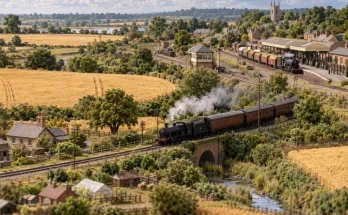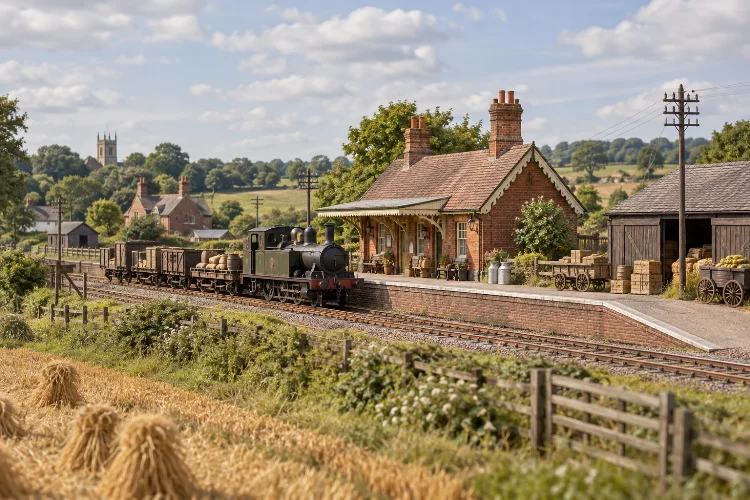
Picture a quiet railway station somewhere in the Suffolk countryside around 1905. A small steam locomotive approaches a modest brick platform, passing open farmland, scattered cottages, and an old goods shed filled with agricultural produce.
There’s no massive railway terminal, no complicated network of tracks, and certainly no modern infrastructure. Yet the scene feels incredibly alive.
That’s exactly what makes modelling Great Eastern Railway infrastructure in rural Suffolk such a fascinating project.
The Great Eastern Railway (GER) played an important role in connecting East Anglia’s agricultural communities with larger towns, ports, and commercial markets.
Its rural stations, branch lines, signal boxes, and goods facilities reflected the practical needs of villages that depended heavily on farming and local trade.
For railway modellers, these historic features offer an opportunity to create something more meaningful than a collection of miniature trains.
You can recreate an entire working railway environment, complete with realistic architecture, operational details, and distinctive countryside scenery.
Whether you’re planning your first historical layout or improving an existing model railway, understanding Suffolk’s railway heritage is the perfect starting point.
1. Understanding the Great Eastern Railway’s Role in Rural Suffolk
Before building a historically accurate model railway, it helps to understand why the original infrastructure existed.
The Great Eastern Railway was established in August 1862 through the amalgamation of several railway companies serving East Anglia. Its network eventually connected London with important destinations across Suffolk, Norfolk, Essex, and Cambridgeshire.
While its principal routes handled substantial passenger and freight traffic, smaller rural lines served a different purpose.
They connected agricultural communities to regional markets, allowing farmers and merchants to transport products more efficiently.
How Rural Branch Lines Supported Local Communities
Consider the Framlingham branch railway, which opened in June 1859 and subsequently became part of the GER network.
This route connected Framlingham with the East Suffolk Line near Wickham Market, serving smaller settlements along the way.
Its importance wasn’t simply about carrying passengers.
Railway facilities supported the movement of grain, livestock, coal, building materials, and other goods essential to the local economy.
For model railway enthusiasts, this historical background explains why a relatively small country station might require several sidings, a loading platform, and multiple storage buildings.
These structures weren’t decorative additions. Each one supported a particular commercial activity.
The key to successful historical railway modelling is understanding the relationship between infrastructure and everyday life.
Instead of filling every available space with track, recreate the practical arrangement of buildings, roads, and railway facilities that made rural transport possible.
2. Choosing the Right Historical Period for Your Suffolk Railway Layout
One of the biggest decisions involves selecting the historical period your model will represent.
Railway infrastructure evolved considerably between the Victorian era and the twentieth century. Buildings were extended, signalling systems changed, and locomotives were replaced as operating requirements developed.
Mixing elements from different decades without careful consideration can make an otherwise attractive layout historically inconsistent.
The Victorian Great Eastern Railway Era
A layout representing the 1870s or 1880s allows you to explore early GER architecture, traditional goods-handling methods, and Victorian railway equipment.
Stations often featured brick construction, pitched slate roofs, timber doors, and architectural details reflecting nineteenth-century design standards.
Goods facilities were particularly important because local businesses still relied heavily on rail transport.
Small warehouses, loading docks, and livestock pens can therefore become major visual features.
The Edwardian Period: 1900–1914
The Edwardian years are another excellent choice.
By this stage, much of Suffolk’s railway network was well established, and rural stations had developed recognisable operational arrangements.
Steam locomotives, semaphore signals, goods wagons, and traditional passenger carriages create a convincing atmosphere.
This period also provides opportunities to represent agricultural communities before motor transport became a dominant competitor.
For a manageable project, a fictional Suffolk station inspired by real GER locations around 1905 can offer flexibility without sacrificing historical character.
Just remember that the GER became part of the London and North Eastern Railway in 1923. A later layout needs appropriate changes to railway branding, rolling stock, and operations.
3. Researching Authentic Railway Infrastructure and Track Plans
A convincing model begins with reliable research rather than guesswork.
Fortunately, historic railway photographs, engineering drawings, maps, and surviving buildings provide valuable evidence of how rural Suffolk stations actually looked.
The Great Eastern Railway Society is an excellent research starting point, particularly for information about infrastructure, locomotives, rolling stock, and regional railway history.
Local history collections can be equally useful.
Using Historical Maps and Station Drawings
Old Ordnance Survey maps can reveal details that ordinary railway photographs overlook.
These include the positions of sidings, access roads, goods sheds, cattle docks, nearby cottages, and boundaries between railway property and farmland.
Framlingham is especially useful because historical station plans show a surprisingly varied goods yard, including grain storage facilities, coal sheds, stables, and other commercial buildings.
Studying these arrangements helps explain how individual facilities fitted together.
Rather than copying every feature, identify the structures most important to your intended scene.
Converting Real Railway Dimensions Into Model Scale
Scale selection determines how much infrastructure can realistically fit into your available space.
British OO gauge, approximately 1:76.2 scale, is popular because it offers a practical balance between detail, available models, and layout size.
At 4 mm per prototype foot, a 300-foot platform would measure approximately 1.2 metres in OO gauge.
A complete station might require considerably more space once approach tracks, sidings, roads, and surrounding buildings are included.
If space is limited, selective compression becomes essential.
You can shorten a platform, reduce the distance between buildings, or omit a secondary siding while retaining the recognisable character of the original station.
However, preserve important relationships.
A goods shed must still connect logically to its siding and road access. A signal box should overlook the area it controls, and a station entrance should connect naturally with the surrounding community.
These relationships matter more than reproducing every measurement perfectly.
4. Designing Realistic Rural Railway Tracks and Platforms
Rural railway layouts often look better when they’re relatively simple.
Unlike major railway junctions, many branch stations operated with limited track infrastructure. A single running line, a passenger platform, and a small goods yard could support a substantial amount of local activity.
The exact arrangement depended on whether the station was a terminus, an intermediate stop, or a junction.
Planning a Believable Track Arrangement
Imagine creating a fictional Suffolk branch-line terminus inspired by Framlingham.
The layout might include a single passenger platform, a run-round loop, a goods siding, and a short track serving a coal merchant.
The run-round loop allows the locomotive to move from one end of its passenger train to the other before the return journey.
Meanwhile, the goods siding provides opportunities for wagons to be delivered and collected.
This arrangement creates operational interest without requiring an excessive number of points.
For accurate modelling, always check whether your chosen prototype actually possessed the facilities you intend to reproduce.
Adding Period Track Details
Track appearance makes a surprisingly large difference.
Modern-looking ballast, perfectly straight sidings, and shiny rails can undermine the atmosphere of a Victorian or Edwardian layout.
For a more realistic appearance, use muted grey-brown ballast, appropriately spaced sleepers, and subtle rail weathering.
Goods sidings should appear less intensively maintained than the main running line, although they must remain mechanically reliable on the model.
Small features such as buffer stops, point rodding, drainage ditches, boundary fences, and trackside equipment help establish the railway’s historical identity.
An important modelling principle is to avoid excessive infrastructure.
The countryside surrounding a modest railway station should remain visually dominant.
5. Recreating Great Eastern Railway Station Buildings and Signal Boxes
Architecture is one of the most distinctive elements of historical railway modelling.
The Great Eastern Railway developed standardised building designs that helped create a recognisable identity across parts of its network.
However, not every Suffolk station followed the same architectural pattern.
Older buildings inherited from predecessor companies often existed alongside later GER structures.
Learning From Clare Railway Station
Clare Station in western Suffolk provides an outstanding example of GER architectural design.
Opened in 1865, its surviving station complex includes a main station building, a platform shelter, and a goods shed.
Historic England identifies the site as an important example of the company’s standardised 1865 building designs.
The architecture features red brickwork contrasted with lighter gault-brick detailing, along with carefully proportioned windows and traditional roof forms.
For modellers, these details offer excellent opportunities for scratch-building.
Plasticard, embossed brick sheets, laser-cut materials, and 3D-printed architectural components can all help recreate the appearance.
Pay attention to window dimensions, roof pitch, chimney placement, and brick colour.
Even relatively simple buildings become convincing when their proportions are correct.
Modelling Goods Sheds and Ancillary Buildings
A goods shed should look like a working industrial building rather than a decorative station accessory.
Clare’s historic goods shed, for example, was built in red brick beneath a slate-covered roof. Its design incorporated large openings for goods movement and internal loading facilities.
When creating a miniature version, include loading doors, a raised platform, gutters, and appropriately weathered surfaces.
Small imperfections make structures appear more realistic.
A few discoloured bricks, faded timber doors, and lightly weathered roof tiles suggest years of practical use.
Creating Historically Appropriate Signalling
Signal boxes and semaphore signals provide another important architectural feature.
The GER’s 1888 signal box at Bury St Edmunds demonstrates the distinctive construction and detailing found in the company’s signalling infrastructure.
However, its substantial size wouldn’t necessarily suit a tiny country station.
Choose a signal box design appropriate to your particular location, period, and track layout.
Likewise, don’t install complicated signalling simply because miniature semaphore signals look attractive.
Each signal should have a believable operational purpose.
6. Modelling Agricultural Goods Yards and Rural Freight Facilities
If passenger stations provide visual character, goods yards often provide the most interesting modelling opportunities.
Suffolk’s agricultural economy depended on transporting grain, livestock, and other farm products to regional and national markets.
Railways also delivered coal, machinery, fertilisers, timber, and manufactured goods to rural communities.
This two-way traffic shaped the infrastructure surrounding local stations.
Grain Warehouses and Agricultural Traffic
Framlingham offers a particularly interesting historical example.
According to the Lanman Museum, the town became an important agricultural railhead, handling significant grain traffic alongside livestock movements.
A model inspired by this history might feature a brick grain warehosue, timber loading doors, a weighing area, and horse-drawn carts delivering produce from nearby farms.
Goods wagons could be positioned beside the loading dock while workers move sacks between storage buildings and railway vehicles.
For a convincing scene, think about the entire freight process.
Where do the carts enter the yard? How are goods weighed? Where are empty wagons stored before loading?
Answering these questions helps create an environment that feels functional.
Coal Merchants and Livestock Facilities
Coal traffic provides another useful modelling opportunity.
A small merchant’s yard might contain coal staithes, storage bins, wooden fencing, and a short siding where mineral wagons are unloaded.
Period-appropriate livestock facilities can introduce cattle pens, loading ramps, and additional fencing.
However, not every station needs every feature.
Select facilities supported by your prototype research, then arrange them according to the available space.
The result should resemble a working rural railway economy, not a collection of unrelated accessories.
7. Capturing the Character of Suffolk’s Rural Landscape
The surrounding countryside is just as important as the railway itself.
Suffolk’s landscape includes gently rolling farmland, river valleys, hedgerows, small woodland areas, and villages built from a mixture of brick, timber, and traditional rendered materials.
The exact appearance varies across the county, so geographical research remains important.
A layout inspired by the coastal districts will naturally differ from one representing inland western Suffolk.
Building Authentic Agricultural Scenery
Start by establishing broad landscape shapes.
Rather than creating dramatic mountains or oversized hills, use gentle changes in ground level that reflect the chosen location.
Fields should extend naturally beyond the railway boundary, with hedgerows marking agricultural divisions.
Static grass, fine turf, textured ground materials, and carefully arranged vegetation can reproduce the appearance of farmland.
Seasonal consistency also matters.
A late-summer scene might feature golden stubble, harvested fields, dusty paths, and relatively dry grass.
A spring layout would require fresher greenery, cultivated soil, and a different balance of vegetation.
Adding Small Details That Tell a Story
The most effective scenery often includes understated human activity.
A farm cart approaching the station, railway workers inspecting a siding, or a cyclist passing a level crossing can establish a believable historical setting.
Telegraph poles, drainage channels, simple wooden fences, and narrow country lanes reinforce the rural atmosphere.
Avoid making every surface perfectly clean.
Subtile variations in soil colour, weathered timber, and worn pathways help produce a more natural environment.
However, keep scenic details in proportion.
A modest station surrounded by open countryside should still feel spacious and peaceful.
8. Recreating Realistic Great Eastern Railway Operations
A historically inspired layout becomes much more engaging when trains operate for a reason.
Instead of continuously running locomotives around the track, recreate the daily activities that took place at rural railway stations.
These might include passenger arrivals, goods deliveries, wagon collection, and locomotive movements.
Planning a Typical Operating Session
For example, an imaginary Edwardian operating session might begin with a morning passenger train arriving from a larger junction.
Passengers disembark while railway staff handle parcels and prepare the train for departure.
Later, a local goods train arrives with coal wagons and general merchandise.
The locomotive must position these vehicles on the appropriate sidings before collecting loaded agricultural wagons for their return journey.
This creates several interesting shunting movements without requiring a large railway network.
The example is a fictional operating sequence rather than a reproduced historical timetable.
Using Historical Timetables and Freight Records
Where possible, consult period working timetables, station diagrams, and railway records.
These can help establish realistic service frequency, train lengths, and operating patterns.
The Lanman Museum’s historical material on the Framlingham branch illustrates how passenger and goods services supported the community over many decades.
For added realism, prepare simple wagon cards identifying each vehicle’s origin, destination, and contents.
One wagon might deliver coal to a local merchant, while another is scheduled to recieve grain from an agricultural warehouse.
This gives every movement a practical purpose.
Single-line operation deserves particular attention. Train movements were controlled through appropriate signalling and train-authority arrangements, which varied according to location and period.
Representing those rules through a simplified token or operating procedure can make a miniature branch line much more engaging.
9. Practical Construction Tips and Common Modelling Mistakes
Even an accurately researched project can become frustrating without a sensible construction process.
The most effective approach is to build the layout in manageable stages.
Begin with the baseboard and track arrangement, ensuring that locomotives can run reliably before adding permanent scenery.
Next, establish platform heights, road positions, and the footprints of major buildings.
Temporary cardboard mock-ups are especially useful at this stage.
They allow you to evaluate proportions and sightlines before spending time constructing detailed architectural models.
Once the overall composition works, begin adding permanent structures and landscape materials.
Avoiding Common Historical Modelling Errors
One frequent mistake is choosing locomotives and rolling stock that don’t match the intended period.
Another is using standard commercial station kits without considering whether their architecture resembles the chosen GER prototype.
Excessive weathering can also make a rural railway appear abandoned rather than operational.
Remember that working railways required regular maintainance, even when resources were limited.
Finally, keep access and reliability in mind.
Concealed points, poorly positioned buildings, and difficult-to-reach track sections can make future repairs unnecessarily complicated.
A successful historical layout should be both visually convincing and enjoyable to operate.
Modelling Great Eastern Railway infrastructure in rural Suffolk offers a rewarding combination of railway history, architectural craftsmanship, and scenic creativity.
From modest brick stations and traditional goods sheds to agricultural sidings and countryside landscapes, every element contributes to the character of a bygone railway.
The strongest layouts aren’t necessarily the largest or most complicated. They’re the ones where buildings, tracks, scenery, and train movements work together to tell a believable story.
Start by choosing a specific historical period, researching an authentic Suffolk location, and designing a practical track arrangement.
Then gradually introduce the architectural and operational details that bring the scene to life.
Ready to begin? Choose a historic Suffolk railway station, explore its original infrastructure, and turn that research into your own miniature piece of East Anglian railway heritage.