
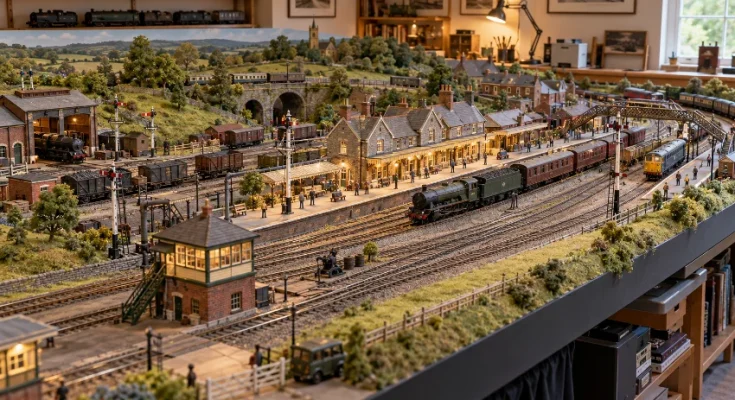
There’s something incredibly satisfying about watching a detailed miniature locomotive travel through a beautifully recreated British railway landscape. From weathered station buildings to realistic signalling systems, model railways capture the engineering, history, and atmosphere of real railway operations.
For enthusiasts interested in Suffolk’s railway heritage, Stowmarket Model Railway offers an inspiring starting point for exploring advanced British railway modelling. The town’s railway connections provide opportunities to recreate historic passenger services, goods yards, and regional railway infrastructure.
This guide explores sophisticated layout planning, scale accuracy, digital train control, realistic scenery, and operational techniques that help transform an ordinary model railway into an engaging miniature railway network.
1. Understanding Stowmarket’s Railway Heritage and Modelling Potential
Stowmarket occupies an important position within Suffolk’s railway geography.
Its station serves the Great Eastern Main Line and connects with routes towards Bury St Edmunds and the wider railway network. This creates an interesting historical setting for enthusiasts who enjoy modelling both passenger and goods operations.
The Historical Importance of Stowmarket Station
The development of rail transport helped connect Stowmarket with larger commercial centres.
Railway services provided opportunities for transporting agricultural products, manufactured goods, and passengers between regional towns and major cities.
The arrival and expansion of railway infrastructure also influenced the growth of businesses around the station.
For modellers, this history provides a useful foundation for recreating different operating periods.
A Victorian-inspired layout might emphasize early railway architecture and traditional goods handling.
A British Rail-era project could instead feature diesel traction, updated signalling, and changing freight operations.
Modern layouts may incorporate contemporary passenger units, electrification infrastructure, and simplified station facilities.
Each period offers distinctive visual and operational possibilities.
The Influence of the Great Eastern Railway
The Great Eastern Railway played a significant role in developing railway services across East Anglia.
Its routes linked London with towns throughout Essex, Suffolk, Norfolk, and Cambridgeshire.
For railway modellers, Great Eastern Railway history offers numerous opportunities to recreate regional station architecture, locomotives, goods facilities, and rural scenery.
Station buildings can be researched through historical photographs, maps, and surviving architectural examples.
Choosing a consistent historical period is particularly important.
Combining unrelated railway liveries, buildings, and signalling equipment may weaken an otherwise impressive historical recreation.
However, fictional layouts can still use selective historical inspiration without attempting complete documentary accuracy.
The Mid-Suffolk Light Railway Connection
The Mid-Suffolk Light Railway, affectionately known as the Middy, provides additional inspiration for modelling rural Suffolk.
The railway opened in 1904 and eventually closed in 1952.
Its route was originally intended to create improved connections through rural communities, although financial difficulties prevented the full network from being completed.
The preserved railway museum at Brockford keeps part of this regional railway story alive.
Importantly, the Middy should not be confused with Stowmarket station itself.
The historic light railway was a separate operation connected to the wider railway network through Haughley.
For modellers, its modest infrastructure and rural character provide an interesting contrast with the busier main-line environment around Stowmarket.
2. Advanced Layout Planning and British Railway Scale Selection
A successful railway layout begins long before the first section of track is installed.
Planning determines whether the finished railway operates reliably, looks convincing, and remains enjoyable to maintain.
Choosing Between OO, N, and O Gauge
British railway modelling offers several established scales.
OO gauge is particularly popular in the United Kingdom. It typically uses a scale ratio of 1:76.2 with 16.5 mm track gauge.
N gauge, commonly modelled at 1:148 for British-outline equipment, allows enthusiasts to recreate larger landscapes within smaller spaces.
O gauge offers more substantial models, with British standard-gauge modelling commonly using 1:43.5 scale and 32 mm track.
Each option involves compromises.
OO provides a broad selection of ready-to-run locomotives and accessories.
N gauge is attractive for recreating expansive main-line routes with longer trains.
O gauge allows impressive detailing but requires considerably more space for comparable track arrangements.
The right choice depends on available room, preferred modelling style, budget, and operational ambitions.
Designing Realistic Track Geometry
Track planning should reflect how real railways operate.
A convincing station needs appropriately positioned platforms, points, sidings, and running lines.
For a Stowmarket-inspired layout, designers might include a main-line section, station platforms, a junction, and a representative goods facility.
However, reproducing every historical track feature may be impractical.
Selective compression allows modellers to preserve recognisable characteristics while reducing overall layout dimensions.
For example, a long station approach could be shortened without removing the key visual relationship between the platforms and junction.
PECO’s track-planning resources encourage modellers to consider available space, operating requirements, and track geometry before beginning construction.
Understanding Minimum Radius and Train Compatibility
Tight curves can create operational difficulties.
Long coaches and modern locomotives often require broader curves than compact industrial engines or short-wheelbase wagons.
The manufacturer’s minimum-radius guidance should be treated as an operational constraint rather than an aesthetic recommendation.
Even when stock can negotiate a tight curve, excessive overhang may look unrealistic.
Broader curves generally improve the appearance of longer passenger trains.
Where space is limited, tight curves can be hidden behind scenery or placed in concealed storage areas.
Visible track should prioritize convincing geometry whenever practical.
Using Fiddle Yards for Operational Flexibility
A fiddle yard represents destinations beyond the visible railway.
It allows trains to enter and leave the scenic section without requiring the modeller to construct an entire railway network.
Fiddle yards can use conventional sidings, traversers, sector plates, or cassette systems.
For example, an East Anglian main-line layout might represent trains arriving from Norwich, Ipswich, Cambridge, or London without physically modelling those destinations.
A well-designed storage area supports greater operational variety while keeping the scenic section manageable.
Its design should provide sufficient access for maintenance and safe rolling-stock handling.
3. Realistic Track Construction and Digital Command Control
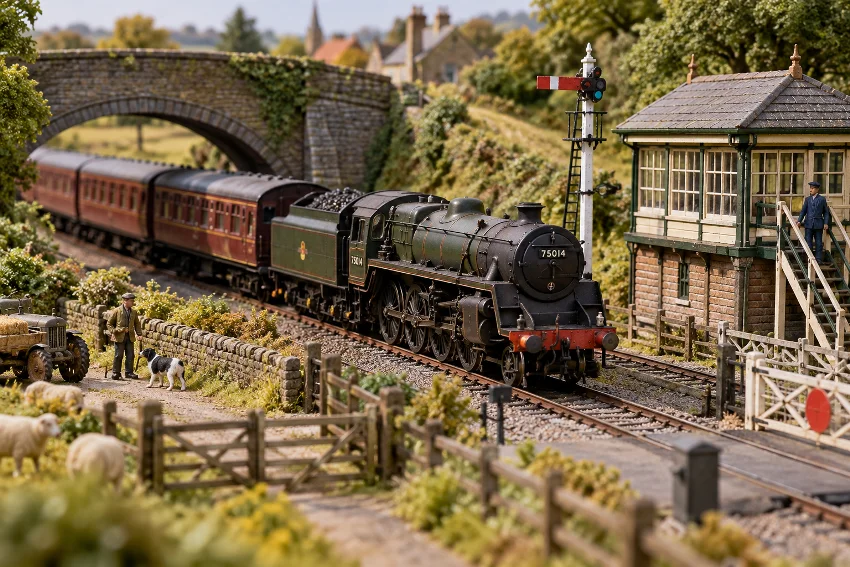
Reliable train movement is essential for an enjoyable model railway.
Beautiful scenery cannot compensate for frequent derailments, unreliable electrical connections, or poorly configured locomotive controls.
Understanding Track Standards and Wheel Compatibility
Different manufacturers produce track systems with varying rail profiles and specifications.
Code 75 and Code 100 track are common choices in OO modelling.
The code number describes rail height in thousandths of an inch.
Code 75 has a finer appearance, while Code 100 provides a taller rail profile that may accommodate some older rolling stock more easily.
However, compatibility depends on wheel flange dimensions and turnout construction.
The National Model Railroad Association publishes technical standards and recommended practices covering trackwork, wheels, clearances, and electrical systems.
These references can help modellers understand why consistent mechanical tolerances matter.
Before constructing an entire layout, test representative locomotives and wagons over the intended track components.
Implementing DCC for Advanced Train Control
Digital Command Control, commonly known as DCC, allows individually addressed locomotives to receive commands through the rails.
Unlike traditional analogue arrangements, operators can control several compatible locomotives independently on the same powered track network.
Each locomotive generally contains a decoder that interprets digital instructions.
Advanced decoders may support lighting effects, sound functions, and adjustable acceleration characteristics.
For a British railway layout, DCC can make station movements and shunting operations feel more authentic.
A diesel shunter can move wagons into sidings while a passenger locomotive waits nearby.
However, DCC installation requires careful planning and appropriate electrical protection.
Designing Reliable Power Distribution
Large model railway layouts benefit from structured wiring.
A power bus distributes electricity beneath the baseboards, while feeder wires connect individual track sections to the supply.
This arrangement reduces dependence on rail joiners as electrical conductors.
On complex layouts, appropriate power districts and circuit protection can help isolate faults.
Pointwork also deserves special attention.
Depending on turnout design, the frog may require switching or suitable electrical configuration.
Incorrect wiring can cause short circuits or unreliable locomotive movement.
Always follow manufacturer instructions, maintain suitable wire sizes, and test each section before permanently installing scenery.
Adding Sound and Realistic Operating Effects
Sound decoders can introduce engine sounds, whistles, horns, and other locomotive effects.
When configured carefully, these features add atmosphere without overwhelming the layout.
Realistic acceleration and braking settings are equally important.
A heavy goods train should not behave like a lightweight racing vehicle.
Some DCC systems also support function mapping, automation, and computer-assisted control.
These features can enhance operations, although they aren’t essential for every project.
The objective is to reproduce believable railway behaviour rather than add technology simply because it’s available.
4. Creating Authentic Suffolk Railway Scenery
Scenery transforms a collection of tracks into a believable miniature environment.
For a layout inspired by Stowmarket and the surrounding countryside, regional geography and architecture provide valuable design references.
Recreating East Anglian Landscapes
Suffolk landscapes are often characterised by agricultural fields, hedgerows, gently changing terrain, and traditional rural buildings.
These features can be recreated through layered scenic techniques.
Static grass provides convincing vegetation textures when applied using suitable equipment.
Fine turf materials, natural fibres, and miniature foliage help introduce variation.
A realistic field shouldn’t appear uniformly green.
Different shades and textures can suggest seasonal changes, cultivated land, and natural vegetation.
Observing real landscapes is often more useful than relying entirely on commercially packaged scenery.
Modelling Historic Station Buildings
Station structures strongly influence the identity of a railway layout.
Research should focus on architectural details appropriate to the selected historical era.
Brick colours, roof materials, window arrangements, platform canopies, and signage contribute to authenticity.
Modellers can combine ready-made kits with scratch-built components.
For example, a commercially available station building might be modified using different doors, chimney details, and roof textures.
Historical photographs can help establish proportions and identify distinctive regional features.
Not every model needs to reproduce a specific prototype exactly.
However, using consistent architectural references helps create a cohesive visual environment.
Advanced Weathering and Surface Detailing
Real railway infrastructure rarely looks permanently new.
Tracks, wagons, buildings, and locomotives develop visual signs of regular use.
Weathering techniques help replicate these effects.
Airbrushing, dry brushing, washes, and weathering powders can introduce subtle variations in colour and texture.
For example, goods wagons may show brake dust, dirt accumulation, and faded paintwork.
Track ballast may appear darker around heavily used points and station approaches.
The most convincing effects are usually restrained.
Excessive rust, grime, or uniform dark colouring can make a layout appear less realistic.
Study photographs of real railway equipment before applying permanent finishes.
Using Lighting to Improve Atmosphere
Lighting can dramatically influence how viewers experience a model railway.
Warm interior lighting may bring station buildings to life, while carefully positioned exterior lights can emphasize platforms and goods yards.
LEDs are widely used because of their compact size and relatively low power consumption.
However, brightness needs careful adjustment.
Oversized or excessively bright lighting can destroy the illusion of scale.
A sophisticated night scene should include areas of darkness as well as illumination.
The aim is to recreate believable visual conditions rather than make every building glow.
5. Advanced Rolling Stock Selection and Prototype Accuracy
Locomotives and rolling stock provide movement, historical identity, and operational purpose.
Selecting suitable models involves more than choosing attractive liveries.
Matching Locomotives to Historical Periods
British railway history includes several major organisational periods.
The pre-grouping era featured independent railway companies such as the Great Eastern Railway.
The grouping of 1923 introduced the London and North Eastern Railway and other major companies.
Nationalisation in 1948 created British Railways, followed by extensive changes in traction and railway operations.
Modern layouts may instead feature post-privatisation operators and contemporary rolling stock.
For a historically focused project, locomotives should match the selected period and intended route.
A locomotive that existed nationally may not have been typical of Suffolk operations.
Researching photographs, working timetables, and historical locomotive allocations can improve accuracy.
Selecting Appropriate Passenger Coaches
Passenger train formations vary according to era and service type.
Historic services might use compartment coaches or early corridor stock, depending on the period.
Later layouts may represent diesel multiple units, locomotive-hauled coaching stock, or electric multiple units.
Coach lengths and coupling arrangements influence track geometry.
Longer formations also require sufficient platform length and storage capacity.
A compressed layout may use shorter trains to preserve operational reliability.
However, modellers should keep these compromises visually consistent.
For example, a carefully composed four-coach train may look more convincing than a longer formation forced around unrealistically sharp curves.
Developing Authentic Freight Operations
Goods traffic can make a railway layout significantly more interactive.
Historic East Anglian railways carried agricultural commodities, coal, manufactured products, and other regional freight.
A Stowmarket-inspired goods yard might include loading facilities, warehouses, sidings, and appropriate period wagons.
Different freight categories require different infrastructure.
Agricultural traffic might involve covered wagons or open wagons, depending on the goods being transported.
A small goods shed could support mixed merchandise traffic, while a coal merchant might occupy a separate siding.
Operational variety becomes more realistic when each wagon has a believable origin and destination.
6. Realistic Railway Operations and Signalling Systems
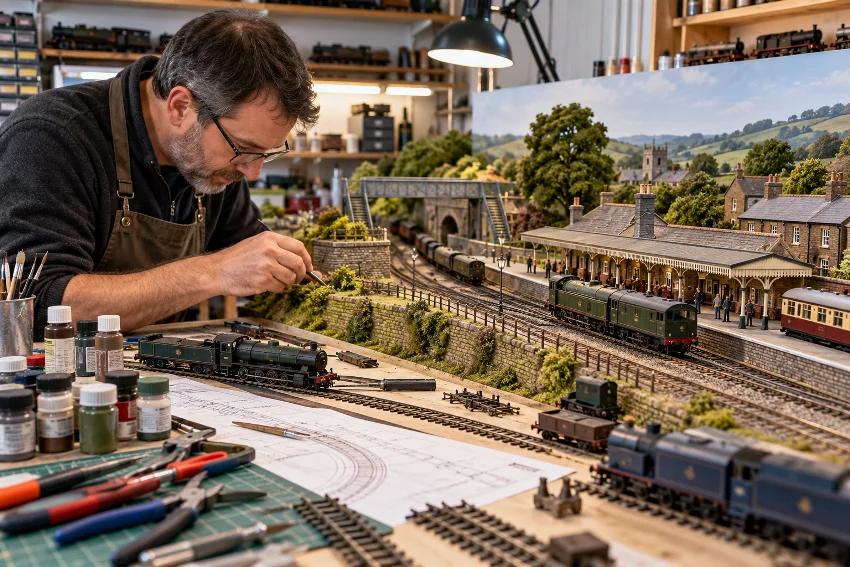
Advanced railway modelling becomes particularly rewarding when trains operate according to defined rules.
Instead of simply running locomotives around a continuous loop, enthusiasts can recreate passenger timetables, goods movements, and station procedures.
Designing a Prototype-Inspired Timetable
A fictional timetable can create structure and variety.
For example, a model railway might simulate a morning operating period with scheduled passenger services and goods movements.
Main-line trains could pass through the station while local freight services perform shunting activities.
The operator must coordinate train movements to avoid conflicting routes.
This approach turns layout operation into an engaging railway simulation.
A timetable doesn’t need to reproduce historic records exactly.
However, it should reflect plausible traffic patterns and the capacity of the modelled infrastructure.
Understanding British Railway Signalling
Railway signalling varies substantially across historical periods and geographical locations.
Mechanical semaphore signals were widely used before modern colour-light systems became dominant.
Signal boxes controlled points and signals according to established operating principles.
A historically accurate layout may require careful consideration of signal placement, block sections, and interlocking arrangements.
Modern layouts introduce different equipment, including colour-light signals and contemporary train-control infrastructure.
Signal selection should therefore follow the model’s chosen era.
Installing random signals purely for decoration can reduce authenticity.
Researching actual signalling diagrams and operational practices provides a much stronger foundation.
Creating Engaging Shunting Operations
Shunting introduces practical challenges that reward careful planning.
Operators may need to collect wagons, assemble trains, and deliver vehicles to specific sidings.
Wagon cards and destination labels can provide instructions for each operating session.
For example, a freight train might arrive with three wagons designated for different local customers.
The shunting locomotive must position them correctly while keeping the main line clear.
This type of operation encourages realistic movements rather than constant high-speed running.
It also makes smaller layouts surprisingly entertaining.
A compact goods yard with thoughtfully designed sidings can support hours of varied operating sessions.
Introducing Computer-Assisted Automation
Some advanced layouts use computer software to coordinate turnout control, train detection, and route setting.
These systems may support automated sequences and realistic operational displays.
However, automation introduces additional complexity.
Train detection requires reliable electrical design, while software control depends on accurately configured track plans.
Manual operation should remain possible when practical.
A phased approach is often more succesful than attempting to automate every feature immediately.
Begin with reliable train control before expanding into sophisticated digital systems.
7. Building a Sustainable Railway Modelling Project
Advanced model railways require time, financial planning, and ongoing maintenance.
The most successful projects balance ambitious design ideas with achievable construction stages.
Establishing a Realistic Project Budget
Railway modelling expenses extend beyond locomotives and track.
Baseboard materials, wiring, scenery, buildings, electronics, tools, and replacement components can contribute significantly to the total cost.
A useful approach is to divide the project into construction phases.
The first phase might focus on baseboards and track infrastructure.
The second could introduce reliable electrical control and testing.
Later stages can add buildings, scenery, signals, and detailed rolling stock.
Planning expenses in advance helps prevent unfinished projects caused by unexpected costs.
Purchasing everything immediately is rarely necessary.
Using Modular Construction Methods
Modular layouts divide a larger railway into manageable sections.
Each baseboard can be constructed, transported, and maintained separately.
This approach is particularly useful for exhibition layouts or projects with limited workshop space.
However, modular construction requires precise track alignment and reliable electrical connections between boards.
Poorly aligned joints can cause recurring derailments.
Standardised connectors and clearly labelled wiring simplify setup and maintenance.
A modular system also allows future expansion without rebuilding the entire railway.
Maintaining Track and Rolling Stock
Routine maintenance is essential for long-term operational reliability.
Dirty rails, worn wheelsets, loose wiring, and damaged couplings can create avoidable problems.
Cleaning should use materials and methods appropriate to the track and locomotive manufacturers’ recommendations.
Over-lubricating locomotive mechanisms can attract dirt and create additional difficulties.
Electrical faults should be investigated systematically rather than addressed through random adjustments.
Keeping basic maintenance records may help identify recurring issues.
A small amount of preventative work can save considerable troubleshooting time.
Learning Through Railway Modelling Communities
Railway modelling is both a technical hobby and a creative community.
Clubs, exhibitions, specialist magazines, and online discussion groups offer opportunities to exchange ideas.
Experienced modellers often provide practical advice about track construction, scenery, electrical systems, and prototype research.
The National Railway Museum also provides research guidance that can help enthusiasts investigate railway history through records, archives, and other historical materials.
Visiting heritage railways can offer additional inspiration.
Observing real trackwork, operational procedures, and weathered equipment helps refine modelling judgement.
Sharing a project’s progress can also encourage constructive feedback.
Every completed section provides an opportunity to learn new techniques and improve the next stage.
Ultimately, the most rewarding layouts combine technical dependability with convincing visual storytelling.
A well-planned Stowmarket-inspired railway can become a detailed miniature interpretation of Britain’s evolving railway heritage.
Stowmarket Model Railway offers fascinating opportunities to explore British railway heritage through detailed layouts, realistic operations, and advanced modelling techniques. By combining historical research, accurate track planning, reliable DCC systems, and carefully crafted scenery, enthusiasts can create engaging miniature railways.
Start by choosing a historical period, researching Suffolk railway operations, and planning a manageable layout. Build progressively, test thoroughly, and enjoy bringing railway history to life.
Professional knowledge develops through exposure to industry discussions, specialized information, and relevant organizations. This professional directory offers an additional avenue for locating sector-specific websites and useful references. Explore these online destinations to discover perspectives that may support deeper research and informed understanding.