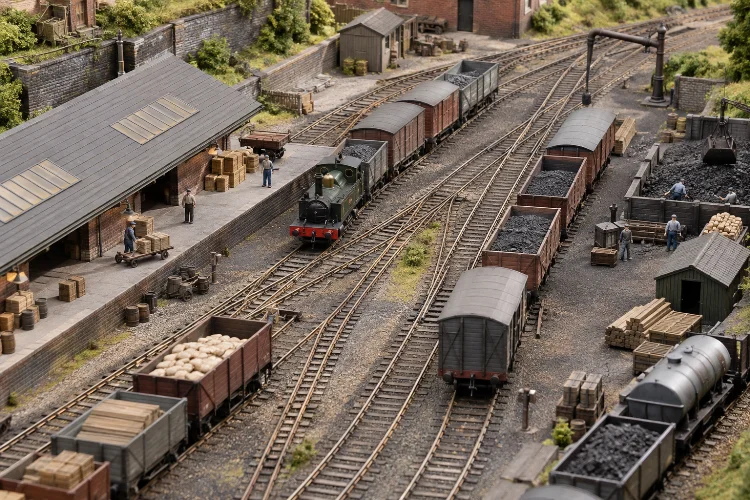
Ever looked at a beautifully detailed model railway yard and wondered how so much operational activity fits into such a small space?
A locomotive slowly pushes wagons into a siding, another train waits for clearance, and a goods yard somehow manages to handle deliveries, departures, and complex shunting movements without becoming completely chaotic.
It looks complicated, but that’s exactly what makes it fascinating.
Planning complex railway yard operations in compact scale layouts requires more than squeezing several tracks onto a small baseboard. It’s about creating a miniature railway system where every siding, turnout, and locomotive movement has a practical purpose.
The challenge is finding the right balance between realistic operations, limited space, reliable track geometry, and enjoyable gameplay.
Whether you’re modelling a British Railways goods depot, a small industrial switching yard, or a fictional branch-line terminus, good planning can transform a surprisingly modest layout into an engaging operational environment.
In this guide, we’ll explore advanced yard design techniques, efficient wagon sorting, realistic operating schedules, and practical solutions that help compact railway layouts perform like much larger railway systems.
1. Understanding the Operational Logic Behind Compact Railway Yards
Before designing a railway yard, it’s important to understand what yards actually do.
Real railway yards aren’t simply collections of sidings where spare wagons are parked. They’re operational facilities designed to receive trains, sort vehicles, organise freight movements, and prepare services for departure.
Even a relatively small goods yard can perform several of these functions.
Identifying the Essential Yard Activities
Most freight-oriented railway yards involve three fundamental processes: receiving traffic, sorting or positioning wagons, and dispatching outgoing vehicles.
A local goods train might arrive carrying coal wagons, agricultural supplies, and general merchandise.
The locomotive then moves individual wagons to their required destinations before assembling the returning train.
On a large prototype railway, these operations may involve multiple locomotives and extensive infrastructure.
On a compact model railway, the same logic can be represented with only a few carefully positioned tracks.
The National Model Railroad Association’s layout planning guidance highlights the importance of appropriate arrival and departure arrangements, classification tracks, and independent switching leads.
These principles are particularly useful when designing operationally interesting layouts.
Define the Yard’s Primary Purpose
Not every yard needs to perform every possible activity.
A rural goods depot might concentrate on unloading coal, distributing agricultural equipment, and handling merchandise.
An industrial layout could focus entirely on moving raw materials between factories and storage facilities.
Meanwhile, a small railway interchange might concentrate on transferring wagons between different routes or operators.
Choosing a clear purpose prevents the layout from becoming overcrowded.
Instead of building six unrelated sidings, you might create three tracks that support a believable sequence of deliveries and collections.
The goal is operational complexity through meaningful movements, not complexity through excessive trackwork.
2. Designing Track Geometry for Maximum Operational Efficiency
Track geometry plays an enormous role in how efficiently a compact yard operates.
When space is limited, even a single poorly positioned turnout can create unnecessary shunting movements or reduce useful storage capacity.
That’s why experienced railway modellers often spend considerable time testing track plans before permanently installing anything.
Positioning Turnouts and Yard Ladders
A yard ladder is the arrangement of points connecting several parallel tracks to a common access route.
Its design determines how easily locomotives can enter different sidings.
In compact layouts, shorter turnouts can save space, but tighter geometry may introduce reliability problems.
The National Model Railroad Association recommends considering equipment dimensions, turnout geometry, and track clearance during planning.
A useful approach is to position the yard ladder so that locomotives can access important sidings without repeatedly obstructing the main running line.
For example, a goods yard connected through one carefully designed throat may operate more efficiently than a larger collection of tracks requiring several awkward reversing movements.
The Importance of Headshunt Length
A headshunt, sometimes called a switching lead, provides space for a locomotive to move wagons clear of points before pushing them into another siding.
Its length directly influences operational flexibility.
Imagine a small OO gauge yard using a shunting locomotive approximately 110 mm long and four-wheel wagons averaging 80 mm including coupling allowance.
Moving three wagons together requires approximately 350 mm of space before additional operating clearance is considered.
A headshunt of around 380–420 mm might accommodate that particular combination, depending on actual vehicle measurements and turnout clearance points.
This is an illustrative calculation, not a universal specification.
If the headshunt is too short, the operator must make more individual movements, and certain arrangements may become impossible.
Avoiding Problematic Curves
Compact yards frequently contain sharp curves and reverse curves.
These can produce coupling difficulties, buffer locking, and derailments, especially during propelling movements.
PECO recommends using the broadest practical curves and choosing minimum radii based on the locomotives and rolling stock involved.
Try to avoid abrupt changes in direction immediately after turnouts.
Where possible, use gentle transitions and keep heavily used shunting tracks relatively straight.
Smooth track geometry makes slow-speed manouvering much more reliable.
3. Maximising Siding Capacity Without Overcrowding the Layout
One of the biggest challenges in compact railway yard planning is deciding how much rolling stock each siding should accommodate.
It’s easy to assume that longer sidings are always better.
However, maximum storage capacity doesn’t necessarily create maximum operational interest.
Sometimes, carefully limited capacity produces more engaging railway movements.
Calculating Useful Siding Length
Start by measuring the actual rolling stock you intend to operate.
Don’t rely entirely on catalogue dimensions, because coupling gaps and different vehicle designs can change the space required.
For example, suppose a siding is intended to accommodate four wagons averaging 80 mm each.
The nominal wagon length totals 320 mm.
Allowing an additional 20–40 mm for clearance and practical positioning suggests a usable length around 340–360 mm.
The exact requirement depends on the vehicles, couplings, buffer stops, and clearance point of the turnout.
Remember that a siding’s usable length begins beyond the point where standing wagons would obstruct an adjacent route.
This distinction becomes extremely important in tightly packed yards.
Balancing Storage and Movement Space
Imagine a yard containing three sidings with capacities of five, three, and three short wagons.
At first glance, this seems like a fairly limited arrangement.
Yet that configuration forms the basis of the famous Inglenook Sidings shunting puzzle.
The challenge involves rearranging eight wagons into a specified five-wagon train using restricted track capacity.
The fascinating part is that the available space is deliberately limited.
Operators must plan movements carefully, temporarily relocate wagons, and think several steps ahead.
This demonstrates an important design principle: space limitations can create operational interest when they are planned intelligently.
Keep Essential Tracks Available
A common mistake is filling every siding to its maximum capacity.
Unfortunately, that leaves nowhere to temporarily position vehicles during sorting operations.
A more flexible approach is to reserve some space for temporary wagon movements.
If a yard contains three operational sidings, one may need to function partly as a sorting or holding track.
That doesn’t mean it must remain completely empty.
It simply means the operating plan should preserve enough capacity for the movements that follow.
A slightly underfilled yard can provide far more satisfying operations than one where every available centimetre is occupied.
4. Using Shunting Puzzles to Create Complex Railway Operations
Shunting puzzles offer one of the most effective ways to introduce challenging railway operations into small layouts.
They combine practical track arrangements with clearly defined movement restrictions.
Two particularly influential examples are Inglenook Sidings and the Timesaver puzzle.
Understanding the Inglenook Concept
Inglenook Sidings was developed by British railway modeller Alan Wright.
The classic configuration uses three sidings capable of holding five, three, and three wagons.
The headshunt accommodates a locomotive and three wagons.
Eight wagons are initially distributed across the sidings, and the operator must assemble a selected five-wagon train in a predetermined order.
What makes the puzzle interesting is that the locomotive cannot move unlimited numbers of wagons simultaneously.
Every decision affects the remaining available space.
According to Carendt’s detailed explanation of the Inglenook puzzle, the arrangement can generate a surprisingly demanding sequence of movements despite requiring only two turnouts.
Adapting Puzzles Into Realistic Railway Yards
A traditional puzzle doesn’t automatically represent realistic railway operations.
However, its underlying principles can be adapted to create convincing industrial or goods-yard activity.
Instead of rearranging randomly numbered wagons, assign each vehicle a realistic destination.
A coal wagon might need to reach a coal merchant, while a covered van must be positioned beside a warehouse.
Another wagon could represent outgoing agricultural produce.
The locomotive’s job is to deliver and collect these vehicles while working within the yard’s physical restrictions.
This creates a believable reason for every shunting movement.
Combining Operational Challenges
For larger compact layouts, you can introduce ideas inspired by John Allen’s Timesaver puzzle.
This design uses several sidings and a run-around arrangement to create additional switching challenges.
However, overly restrictive trackwork can become frustrating if every operating session requires dozens of unnecessary movements.
The trick is to combine realistic railway tasks with manageable complexity.
Allow enough flexibility for operators to develop different solutions without making the system impossible to operate.
A good shunting layout should reward careful thinking rather than punish small mistakes.
5. Creating Realistic Wagon Routing and Freight Distribution Systems
Once the track arrangement is established, the next challenge is deciding where wagons should go.
Without a logical routing system, railway operations quickly become repetitive.
Trains arrive, wagons move around, and the same vehicles eventually return to their original positions without any meaningful purpose.
A realistic freight distribution system changes that.
Assigning Industrial Destinations
Give each siding a specific operational identity.
For example, imagine a fictional British Railways goods yard representing the early 1960s.
One siding serves a coal merchant, another provides access to a warehouse, and a third handles agricultural deliveries.
Each destination receives particular wagon types.
Coal merchants require appropriate mineral wagons, while warehouses might receive covered vans containing general merchandise.
Agricultural traffic could include machinery, fertiliser, animal feed, or seasonal produce, depending on the location.
Matching freight traffic to local industries helps establish a convincing historical setting.
Introducing Wagon Cards and Waybills
Wagon cards are simple operating documents that identify individual vehicles.
A card might record the wagon number, type, load, origin, and destination.
Waybills provide movement instructions that can change between operating sessions.
For example, a covered van arriving from a regional distribution depot might be assigned to the warehouse siding.
During the next session, that same wagon could become an outgoing empty vehicle requiring collection.
This creates continuity between sessions.
Instead of randomly selecting wagons, the operator follows a miniature logistics system.
Managing Wagon Movement Priorities
Real freight operations involve priorities and restrictions.
Some wagons need unloading before others can be positioned, while outgoing traffic may need to depart before incoming deliveries are handled.
A compact yard can simulate these constraints without becoming unnecessarily complicated.
For example, an operator might need to remove an empty coal wagon before delivering a loaded replacement.
If the empty wagon is blocked by another vehicle, additional shunting becomes necessary.
These small challenges make yard operations feel purposeful.
They also encourage operators to plan several moves in advance instead of simply shifting wagons randomly.
6. Scheduling Yard Activities for Smooth Operating Sessions
A well-designed track plan becomes considerably more interesting when paired with a realistic operating schedule.
Timetables give structure to movements and create a connection between the yard and the wider railway network.
They also help prevent operational conflicts.
Creating a Practical Yard Timetable
Start with a simple sequence of events rather than attempting to reproduce a complicated national railway timetable.
For a fictional branch-line goods yard, an operating session could begin with a morning freight arrival.
The locomotive then detaches the train, sorts incoming wagons, collects outgoing vehicles, and assembles the return service.
An illustrative 60-minute model operating session might allocate 10 minutes to receiving the train, 25 minutes to shunting, 15 minutes to assembling the departing formation, and 10 minutes to departure and resetting.
These are suggested activity blocks, not historical prototype timings.
Actual duration depends on the yard’s complexity, train length, coupling system, and operator experience.
Introducing Operational Conflicts
Controlled conflicts can add excitement to a model railway.
For example, a local passenger train might need to use the same section of track while the goods locomotive is working.
The yard operator must then temporarily clear the running line.
This introduces a realistic reason to organise movements efficiently.
However, conflicts should remain manageable.
If the layout constantly requires trains to stop because essential tracks are blocked, the design may need revising.
Operational interest should come from meaningful decisions, not from permanent congestion.
Using Fiddle Yards to Represent Distant Destinations
A fiddle yard represents railway locations beyond the visible scene.
It can store incoming trains, prepare outgoing services, and allow different freight formations to enter the modelled area.
World of Railways explains that fiddle yards help create the impression of a larger railway network.
For compact layouts, a short cassette system or small traverser can be particularly useful.
These arrangements allow different trains to appear without requiring extensive hidden trackwork.
Even a single removable cassette can introduce significant variety.
For instance, the same visible yard might receive a coal delivery in one session and a mixed goods working during the next.
That flexibility makes a small railway feel much larger than its physical dimensions.
7. Improving Slow-Speed Reliability and Yard Control Systems
Complex yard operations depend on reliable low-speed locomotive control.
Unlike mainline running, where trains usually move continuously, shunting involves frequent stops, reversals, coupling movements, and very short journeys.
Minor track or electrical problems become especially noticeable during these activities.
Maintaining Reliable Electrical Connections
Turnouts, rail joints, and lightly used sidings can all become sources of electrical interruption.
Where appropriate, install dedicated track feeds rather than relying entirely on mechanical rail joiners.
This helps maintain consistent power delivery across the yard.
Point frog polarity also requires attention.
Some turnout designs use live frogs and need correctly arranged switching to prevent short circuits.
Other designs use insulated frogs but may create short dead sections that affect certain short-wheelbase locomotives.
Neither arrangement is automatically perfect for every layout.
The best choice depends on your locomotives, control system, and track components.
Choosing Between DC and DCC Control
Traditional DC control can work extremely well for compact yards, particularly when only one locomotive operates at a time.
It’s relatively straightforward and may suit a modest switching layout.
Digital Command Control, or DCC, allows individual decoder-equipped locomotives to receive independent commands through a shared track supply.
This can be useful when a yard contains multiple working locomotives.
However, DCC doesn’t eliminate the need for sound wiring, clean track, or reliable pointwork.
For a single-locomotive industrial layout, upgrading to DCC isn’t automatically necessary.
Choose the system that supports your actual operating requirements.
Improving Coupling and Uncoupling
Automatic or remote uncoupling can make yard operations more immersive.
Magnetic couplers and strategically placed uncoupling devices allow wagons to be seperated without constantly reaching into the scenery.
However, these systems need careful alignment and testing.
Unreliable coupling behaviour can quickly interrupt an otherwise enjoyable operating session.
Test the couplings with your most frequently used wagons, especially when pushing short formations through curves and points.
8. Testing and Refining Compact Yard Operations
Even the most carefully planned railway yard needs practical testing.
A design that looks excellent on paper may contain hidden operational limitations.
Perhaps a locomotive cannot clear a turnout, or a siding becomes inaccessible when another track is occupied.
These problems are much easier to solve before permanent construction.
Build a Temporary Track Arrangement
Before securing the track, assemble a temporary version of the yard.
Use the actual locomotives and wagons intended for regular operation.
Try several different shunting scenarios.
Can the locomotive reach every siding? Can wagons be rearranged without using impossible movements? Is there enough space to assemble departing trains?
Testing with real rolling stock reveals problems that digital track-planning software may not identify.
Measure Operational Efficiency
One useful technique is to record how many locomotive movements are needed to complete a particular task.
For example, assign five wagons to three destinations and count the shunting movements required.
Repeat the exercise using slightly different track arrangements.
A revised turnout position might reduce unnecessary reversals, while a longer headshunt could allow more efficient wagon transfers.
However, fewer movements shouldn’t always be the ultimate objective.
Some operational complexity is desirable because it creates an interesting challenge.
The goal is to eliminate frustrating inefficiency while preserving realistic railway activity.
Design for Operator Accessibility
Compact layouts can become surprisingly difficult to operate if essential trackwork is hidden behind scenery.
Keep turnout controls accessible and ensure operators can see the relevant wagon positions.
If using manual uncoupling, leave enough space to reach the vehicles safely.
For exhibition layouts, consider where visitors will stand and whether they can observe the main shunting movements.
A well-positioned goods yard can provide excellent entertainment because the audience can follow each operation.
Refine the Layout Over Time
Your first track plan doesn’t need to be perfect.
Many experienced modellers adjust sidings, add operating restrictions, or modify their timetables after discovering how a railway behaves during regular use.
Keep a record of repeated derailments, confusing movements, and operational bottlenecks.
If the same problem appears during every session, investigate its underlying cause.
Occassional changes to track access, wagon allocation, or scheduling may solve problems without requiring major reconstruction.
Regular maintenence and thoughtful adjustments are essential for keeping complex operations enjoyable.
The best compact railway yards evolve through practical experience rather than remaining completely unchanged after construction.
Planning complex railway yard operations in compact scale layouts is all about making limited space work intelligently.
By combining efficient track geometry, carefully calculated siding capacity, realistic shunting procedures, and structured freight movements, you can create a miniature railway that delivers surprisingly sophisticated operations.
Techniques such as Inglenook-inspired track arrangements, wagon cards, operating timetables, and compact fiddle yards help transform simple sidings into a realistic transport system.
Reliable electrical connections, accessible controls, and thorough testing make the experience even more enjoyable.
Remember, a successful model railway yard doesn’t need dozens of tracks or enormous baseboards. It needs purposeful movements, believable traffic, and enough operational flexibility to remain engaging.
Ready to design your own compact railway yard? Sketch a practical track plan, assign real destinations to your wagons, and experiment with shunting sequences before beginning permanent construction.