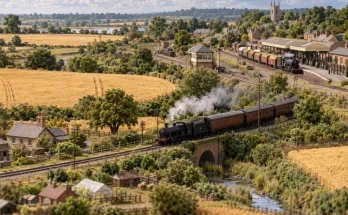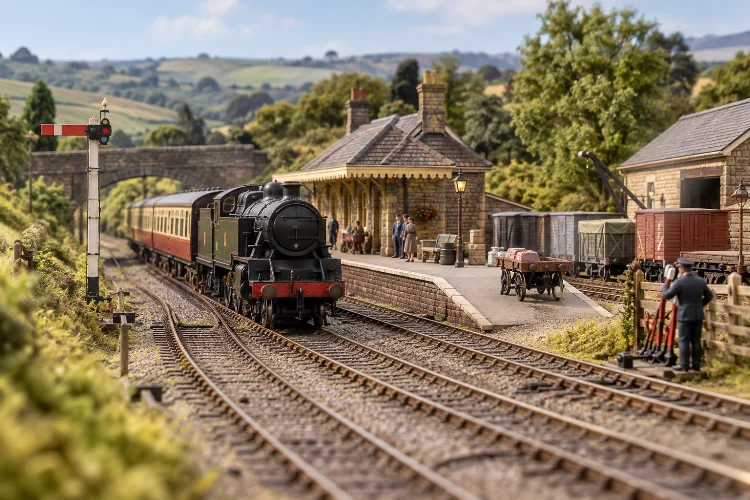
Imagine standing beside a miniature railway station somewhere in the English countryside during the 1950s. A steam locomotive slowly approaches the platform, the signalman prepares the points, and a small goods train waits patiently for permission to enter the yard.
Everything feels like a scene straight out of British railway history.
Now imagine recreating that entire experience on your own model railway layout.
That’s what makes historic railway modelling so fascinating. It’s not simply about collecting beautiful locomotives or building realistic countryside scenery. The real excitement comes from understanding how railways actually operated and bringing those daily routines back to life.
Recreating historic British railway operations in scale models combines historical research, thoughtful track planning, realistic train movements, and a little creativity.
Whether you’re interested in Victorian railways, the famous Big Four companies, or British Railways during the steam-to-diesel transition, there’s plenty of operational history to explore.
This guide explains how to transform an ordinary model railway into a convincing miniature transport system where every locomotive movement, freight delivery, and station stop has a genuine purpose.
1. Understanding Historic British Railway Operations
Before building an operationally realistic railway, it helps to understand how Britain’s railway system developed.
Different historical periods had different locomotive fleets, traffic patterns, signalling arrangements, and operating traditions. Choosing the right era makes everything else easier.
From Victorian Railways to the Big Four
During the nineteenth century, Britain developed an extensive network of railway companies serving industrial towns, ports, agricultural districts, and major cities.
Each company established its own operating procedures, locomotive designs, and infrastructure standards.
In 1923, most of Britain’s main-line railway companies were consolidated into four major groups:
- Great Western Railway (GWR)
- London, Midland and Scottish Railway (LMS)
- London and North Eastern Railway (LNER)
- Southern Railway (SR)
This period is especially attractive to railway modellers because each company had distinctive locomotives, liveries, coaching stock, and regional characteristics.
A GWR branch line in Devon, for example, would look and operate quite differently from an LNER suburban station near London.
British Railways and the Transition Era
Nationalisation arrived on 1 January 1948, bringing the Big Four networks into the state-owned British Railways system.
However, locomotives and infrastructure didn’t suddenly change overnight.
Former company engines continued working alongside newer designs, making the 1950s particularly interesting for historical railway modelling.
Dieselisation, changing freight patterns, and declining branch-line services gradually transformed railway operations during the following decades.
For beginners, selecting a specific year, railway region, and location provides a practical foundation for authentic operations.
Instead of modelling everything from 1920 to 1970, concentrate on one believable historical snapshot.
2. Researching Authentic British Railway Practices
Historical accuracy starts long before the first section of track is installed.
The best operational layouts are based on how real railway employees managed trains, passengers, goods, and infrastructure.
Fortunately, railway enthusiasts have access to an impressive collection of surviving historical records.
Working Timetables and Railway Documents
A public timetable tells passengers when trains arrive and depart.
A railway working timetable goes much deeper.
These documents include operational train movements, intermediate timings, service classifications, and information relevant to railway staff.
Historical working timetables can reveal patterns that aren’t immediately obvious from photographs.
For example, a quiet rural station might receive only a handful of passenger trains daily but still handle goods workings, parcels traffic, and occasional special movements.
Other useful research materials include locomotive allocation records, track diagrams, signalling plans, station photographs, and railway company instructions.
Websites preserving British railway documents can be particularly valuable when reconstructing a specific route.
Learn the Purpose Behind Every Movement
Instead of asking which trains you want to run, ask why those trains would appear.
A coal wagon might be delivering household fuel to a village merchant. A covered van could carry agricultural supplies, while a passenger train might connect a branch terminus with a larger junction.
These practical details turn random train movements into believable railway activity.
Historical research also prevents strange combinations, such as running locomotives that were never allocated to the chosen region.
You don’t need perfect historical knowledge immediately. Start with a clear operating concept and refine the details as your research develops.
3. Designing a Layout for Realistic Railway Operations
A visually impressive layout isn’t automatically enjoyable to operate.
Some model railways have elaborate scenery and extensive track networks but offer surprisingly little opportunity for meaningful train movements.
Operational design requires thinking about what trains actually need to accomplish.
Choosing the Right Track Arrangement
A small branch-line terminus can provide remarkable operational variety.
Consider including a platform road, run-round loop, goods siding, and locomotive servicing area where historically appropriate.
The run-round loop allows a conventional locomotive-hauled train to change direction without requiring another engine.
Goods sidings create opportunities for wagon delivery and collection, while the station platform supports scheduled passenger services.
A hidden fiddle yard can represent the rest of the railway network beyond the visible scene.
This is especially useful when available space is limited.
Rather than constructing an entire railway route, you model one interesting section while allowing trains to arrive from unseen destinations.
Balance Complexity With Practicality
Adding more points and sidings doesn’t necessarily create better operations.
Every track should serve a realistic purpose.
For instance, a small agricultural station might need a loading dock and coal siding, but an enormous locomotive depot would probably be inappropriate.
Use historical station plans as inspiration rather than copying every detail without considering available space.
In OO gauge, a typical British scale of approximately 1:76, even a modest station can require substantial room.
N gauge, at approximately 1:148 in British practice, allows longer trains and broader landscapes within the same area.
The important thing is creating enough space for locomotives to move, couple, uncouple, and complete their assigned work.
4. Selecting Historically Accurate Locomotives and Rolling Stock
Choosing the correct trains is one of the most satisfying aspects of recreating British railway history.
However, authenticity involves more than matching locomotive colours.
You also need to consider where particular engines worked and what services they operated.
Match Locomotives to Their Duties
Large express locomotives were designed for heavy, relatively fast passenger services.
Smaller tank engines were often better suited to local passenger workings, short freight trips, and shunting.
For a fictional Western Region branch line set in 1955, a GWR-designed 14xx 0-4-2 tank locomotive could work a compatible autocoach service.
A 57xx pannier tank might handle local goods movements.
These combinations make operational sense within an appropriate historical setting.
By contrast, placing a major express Pacific locomotive on every tiny rural branch would usually feel unrealistic.
Study actual locomotive allocations where possible, especially when modelling a named station or route.
Build Convincing Train Formations
Passenger trains should have formations appropriate to their route and period.
A lightly used branch line might operate with one or two coaches, while major routes could require considerably longer formations.
Freight operations offer even greater variety.
Traditional goods trains frequently carried combinations of open wagons, covered vans, and specialised vehicles, with a guard’s brake van commonly positioned at the rear.
Wagon types should also reflect the industries being served.
Coal wagons make sense near a fuel merchant, while livestock wagons are more believable where suitable agricultural traffic existed.
Avoid assembling completely random trains simply because the vehicles happen to be available.
A smaller, carefully researched collection often creates a more convincing railway than a large fleet without a consistent historical identity.
5. Creating Realistic Railway Timetables
One of the easiest ways to improve a model railway is to introduce a timetable.
Without one, trains may simply circulate whenever an operator feels like moving them.
A timetable gives each service a purpose and creates relationships between different movements.
Understand How Historical Services Interacted
British railway operations depended on coordinating passenger traffic, freight trains, locomotive movements, and shunting activities.
A passenger service might have priority over a slower goods train.
At a junction, an arriving branch passenger train could need to clear the line before another movement was authorised.
On a model railway, these restrictions create enjoyable operational challenges.
Rather than running trains continuously, operators must decide when and where movements can safely take place.
A simplified timetable might contain morning passenger arrivals, a midday goods working, and an afternoon return service.
The schedule doesn’t need to reproduce every historical minute perfectly.
It should simply reflect the type and frequency of traffic appropriate to the location.
Using a Fast Clock
A fast clock allows several hours of railway activity to fit into a shorter modelling session.
For example, a 4:1 clock ratio represents four hours of railway time during one real hour.
This can work well when operating a timetable containing several scheduled services.
However, switching points, coupling wagons, and arranging freight movements still takes real time.
If the clock runs too quickly, operators may feel rushed rather than immersed.
Start with ordinary time or a modest accelerated clock before experimenting with more demanding schedules.
The ultimate goal is enjoyable realism, not unnecessary pressure.
6. Recreating Traditional Goods Yard and Shunting Operations
Freight handling was a major part of Britain’s historic railway system.
Before road transport became dominant, countless small stations handled coal, agricultural products, building materials, machinery, and general merchandise.
Recreating these activities gives a model railway much more operational depth.
Understanding Pick-Up Goods Trains
A pick-up goods train served multiple stations along a route.
Instead of travelling directly between two major terminals, it stopped to deliver and collect individual wagons.
Imagine a small train arriving at a rural station with six wagons.
Two wagons are destined for the coal merchant, one needs unloading beside the goods shed, and another must be collected from an agricultural siding.
The locomotive must arrange these movements while keeping the running line available for other services.
Suddenly, a simple station becomes the centre of an engaging operating session.
Creating Wagon Cards and Waybills
One practical technique involves assigning each freight wagon an individual operating card.
The card identifies its type, current location, and destination.
A separate waybill can describe the fictional shipment being carried.
For example, a covered van might be assigned to recieve agricultural machinery from a regional distribution depot.
Once delivered, the wagon remains at the siding until another instruction authorises its collection.
This creates a continuing sequence of freight movements rather than resetting the layout after every session.
It also encourages operators to think carefully about wagon placement.
Realistic Shunting Takes Planning
Shunting isn’t simply pushing wagons backwards and forwards.
Operators must consider siding capacity, locomotive access, points, and the order in which vehicles need to be moved.
Sometimes, an inconveniently positioned wagon must be moved temporarily before the desired vehicle can be collected.
That’s exactly the kind of problem that makes railway operations interesting.
On a compact layout, even three or four active sidings can provide substantial entertainment.
The important detail is giving every wagon a believable destination and operational reason for moving.
7. Modelling Traditional Signalling and Safety Procedures
Railway signalling adds another level of authenticity to historic operations.
For many years, semaphore signals and mechanically operated points were familiar features across Britain’s railway network.
These systems helped control train movements and reduce the risk of conflicting routes.
Understanding Block Signalling
Traditional block signalling divides a railway into sections.
Under the usual absolute block principle, a train normally cannot enter a section until the required permission has been obtained and the section is available.
Signal boxes communicate train movements and control access to the line.
A model railway can recreate this principle without reproducing every mechanical detail.
For example, an operator controlling one station can request permission before sending a train towards the next station.
Another operator can confirm when the section becomes clear.
Even a simplified arrangement adds operational discipline and makes each train movement feel significant.
Single-Line Token Working
Single-track railways require particular care because trains can travel in both directions.
Historically, various train staff, staff-and-ticket, and electric token systems provided authority to enter single-line sections.
The exact procedure depended on the location and period.
For modelling purposes, a physical token can represent permission to occupy a particular section.
An operator must obtain the correct token before entering that section and surrender it according to the chosen operating rules.
This simple addition can make a branch-line layout feel considerably more authenic.
Signals should also be positioned according to researched track and signalling arrangements, rather than being installed purely as decorations.
8. Adding Historical Atmosphere and Operational Detail
Authentic operations become even more convincing when the surrounding environment supports the chosen period.
Small details often make a bigger difference than expensive equipment.
A 1930s station should reflect the architecture, advertising, road vehicles, and working practices of that period.
Likewise, a 1960s scene might include newer diesel locomotives, changing station facilities, and evidence of railway modernisation.
Weathering and Everyday Railway Life
Historic railways were working environments, not perfectly clean museum displays.
Locomotives accumulated soot, goods wagons developed worn paintwork, and station yards frequently showed signs of heavy use.
Subtle weathering can reproduce these conditions.
However, avoid making every vehicle equally dirty.
Recently painted locomotives, older freight wagons, and frequently used coaches would often have different appearances.
Adding railway workers, luggage trolleys, platform lamps, coal merchants, and appropriate goods sheds helps communicate what the station actually did.
Sound-equipped locomotives can also improve immersion, particularly when the sounds suit the engine and historical setting.
Reliable Technology Matters More Than Special Effects
Modern digital command control, commonly called DCC, allows operators to control individual locomotives and use functions such as lighting and sound.
But sophisticated technology isn’t essential for historically accurate operations.
Traditional analogue control can support an excellent timetable-driven layout.
Whatever system you choose, reliable electrical connections, properly adjusted couplings, and smooth low-speed locomotive performance are extremely important.
Frequent derailments and unreliable uncoupling can interrupt even the most carefully prepared operating session.
Prioritise dependable operation before adding complicated automation.
9. Example: Operating a British Branch Line in 1955
Let’s put these ideas together with a fictional railway.
Imagine a Western Region branch terminus named Ashcombe Road, located in a small agricultural community during the summer of 1955.
The station has one passenger platform, a run-round loop, a goods shed siding, and a short coal merchant’s siding.
A hidden fiddle yard represents the junction connecting the branch to the wider railway network.
A Typical Morning Operating Session
The morning begins when a 14xx tank locomotive arrives with its autocoach.
After passengers have disembarked, the train waits for its scheduled return movement.
Later, a pannier tank arrives with a short goods train, once the route is available under the layout’s chosen signalling rules.
The locomotive delivers a covered van to the goods shed and positions loaded coal wagons for the local merchant.
An empty wagon must then be collected, requiring several careful shunting movements.
Before the goods train departs, the operator must restore the points, assemble the outgoing vehicles, and position the brake van correctly.
Only then can the train leave for the junction.
The fictional session might represent several hours of railway activity but require only 45–60 minutes of actual operation.
Introduce Occasional Variations
Real railway operations didn’t follow identical patterns every day.
Special livestock traffic, seasonal agricultural shipments, or additional passenger services could change the normal schedule.
A delayed freight arrival might also affect planned movements.
Introduce such variations occassionally to keep operating sessions interesting.
For example, a market-day passenger service could increase activity at the station, while an unexpected wagon delivery creates additional shunting work.
The key is keeping these changes believable.
A branch line should remain a branch line, even when the session becomes unusually busy.
10. Common Mistakes When Recreating Historic Railway Operations
One frequent mistake is concentrating entirely on scenery while neglecting operational planning.
A beautiful model railway may become repetitive if trains have no meaningful destinations.
Another problem is mixing locomotives, buildings, and rolling stock from incompatible periods without a clear historical explanation.
Some modellers also create track layouts with too many sidings or insufficient room for practical shunting.
This can make operating more frustrating than enjoyable.
Before permanently fixing track, test the proposed movements using temporary track sections or a planning program.
Check whether locomotives can run around trains, whether sidings hold the required wagons, and whether operators can reach essential controls.
Regular track cleaning and basic maintenence are just as important as visual accuracy.
Finally, don’t assume historical realism means making everything unnecessarily complicated.
Start with simple rules and gradually introduce more detailed procedures as your knowledge and confidence grow.
11. Improving Your Layout Through Historical Research
A good operational model railway is never completely finished.
New photographs, historical documents, and conversations with experienced railway enthusiasts can reveal details worth incorporating.
Visiting preserved railways and transport museums is particularly useful.
Watching real shunting demonstrations, studying signal boxes, and examining historic vehicles can provide insights that photographs alone cannot communicate.
Try keeping a record of each operating session.
Note which movements worked smoothly, which sidings caused difficulties, and whether the timetable felt believable.
Over time, these observations will help you develop a more enjoyable and convincing miniature railway.
Remember that historical authenticity is a process of continuous learning, not a requirement to get every detail perfect immediately.
Recreating historic British railway operations in scale models is about much more than running beautiful locomotives around realistic scenery.
It’s about understanding the people, procedures, and everyday activities that kept Britain’s railways moving.
By choosing a specific historical period, researching genuine operating practices, designing functional track arrangements, and introducing realistic timetables, you can create a layout that feels like a working railway rather than a static display.
Traditional goods handling, semaphore signalling, and carefully selected rolling stock add further depth to the experience.
You don’t need an enormous layout or a collection of expensive locomotives to get started.
Begin with one small station, a few appropriate trains, and a simple operating schedule. Then gradually introduce more historical detail.
Your next model railway session could become a surprisingly convincing journey into Britain’s railway past.